How to Visit the Giant’s Causeway in Northern Ireland (& For Free)
⋆˙⟡♡︎ This post may contain affiliate links. Please see my disclosure policy for details. Thanks for your support ⋆˙⟡♡︎
A visit to the Giant’s Causeway is a bucket-list experience in Northern Ireland.
It’s a magical, sacred, ancient place with about 40,000 black basalt columns that lead to the ocean.
The National Trust preserves it, but many visitors don’t realise you don’t have to pay to enter their visitor centre or visit during its operating hours.
As it’s the coast, they can’t technically close it, and there’s no ticket barrier for the Atlantic Ocean.
So, here is how to visit the Giant’s Causeway in Northern Ireland and even how to see it for ‘free’.

What is the Giant’s Causeway?
The Giant’s Causeway is an area of the Causeway Coast in Northern Ireland made up of over 40,000 interlocking stone pillars.
These basalt columns are thought to have formed over 60 million years ago when molten lava cooled and cracked during the Palaeogene Period.
The name comes from folklore about Finn McCool besting the Scottish giant Benandonner, creating this phenomenon.
Today, it’s an iconic landmark and a UNESCO World Heritage Site, designated in 1986 for its unique geological features.
It’s also the country’s number one attraction. So, you cannot miss visiting this magical place in Northern Ireland.


How to visit the Giant’s Causeway
The Giant’s Causeway is located on the Causeway Coast AONB, near Bushmills.
It’s very easy to access from Causeway Road if you’re on a road trip. You can drive to it:
- 1 hour from Belfast
- 20 minutes from Ballycastle
- 20 minutes from Coleraine
- 15 minutes from Portrush
Because the Giant’s Causeway is on the coast, visitors must park and walk down to visit.
Although there are plenty of parking/visiting options, the most popular place to park is the Giant’s Causeway National Trust Visitor Centre.
You can also take a public bus from Belfast, Ballycastle or Coleraine to Bushmills, or visit as part of a guided tour from Belfast or Dublin.

The address is National Trust – Giant’s Causeway Visitor Centre, 44 Causeway Rd, Bushmills BT57 8SU. Click here for a Google Pin.

Why not take a guided tour?
If you’re not driving in Northern Ireland and would rather not deal with travel planning, there are many guided tours to the Giant’s Causeway:

Tours & Tickets
Opening times and prices
Technically, the Giant’s Causeway doesn’t ‘close’ as it’s part of the coastline.
But the National Trust Giant’s Causeway Visitor Centre and car park are open from 9 am to 6 pm.
Tickets cost £16 and must be booked in advance. National Trust members can visit and park for free.
I recommend paying, as it makes the visit more of an experience with important context.
They also run a shuttle bus down to the causeway and provide an audio guide, but it’s not required.
Many people don’t know that you don’t have to pay to visit the Giant’s Causeway. You’re only paying for the car park and visitor centre.
Because the attraction is open 24 hours a day, you can visit the Giant’s Causeway for free in several ways.

Can you visit the Giant’s Causeway for free?
Yes, the Giant’s Causeway is part of the natural coastline and doesn’t have a ticket barrier.
So, it’s technically ‘free’ to visit. But you’ll still need to pay for parking, transport or a hotel.
You can visit without paying for the visitor centre and also visit outside of the centre’s operating hours. There are a couple of ways to do this:
- Use a different car park and walk down to the Giant’s Causeway
- Walk along the Causeway Coast as part of a larger walk
- Take the bus to Bushmills and walk down
- Stay at the Causeway Hotel for the night
Visiting outside of opening hours also means fewer visitors. When the centre is open, it’s packed with people and tour groups.
Sunrise and sunset are particularly magical to spend here. I’ve done it a few times now, and it’s utterly breathtaking.


Things to do at the Giant’s Causeway
The obvious draw of the Giant’s Causeway is the mystical basalt columns submerged in the ocean.
But there is plenty to do around the area that makes it worth visiting beyond that.
Here are all the magical things to do at the Giant’s Causeway.

1. Learn the Giant’s Causeway legend
So, why is it called the Giant’s Causeway? Before scientists explained these columns, there was room for speculation and stories.
Countless legends and myths surround this area, but the most popular is the legend of Finn McCool and the Scottish giant Benandonner.
Benandonner threatened Ireland, and so Finn McCool tore up the Antrim coast. He placed stones in the ocean to build a bridge to Scotland.
When he arrived, he realised Benandonner was a terrifying giant, so he fled back home in a panic.

His wife Una hatched a clever idea: she cradled Finn in her arms, acting as if he were a giant baby.
When Benandonner saw this mammoth child, he assumed the father must be even bigger than he was.
Scared, he fled back to Scotland, destroying the bridge in his wake so that Finn couldn’t follow. That’s how the Giant’s Causeway was created.
There’s also a version where Finn builds the bridge to meet the Scottish maiden, Mary Ann. He built the causeway in order to see his love.


2. Giant’s Causeway Visitor Centre
You can learn more about this magical legend at the National Trust Visitor Centre.
Beyond the myths, they also have a fabulous exhibition about how the Giant’s Causeway was formed.
This gives you both historical and geological context for your visit, which I think helps you understand what you’re seeing much better.
You can then visit their fabulous gift shop, filled with fun souvenirs, or take a break in their tearoom.
Don’t forget to pick up an audio guide before you head down to the coastal columns.


3. Walk or shuttle to the Giant’s Causeway
From the visitor centre, there are two ways that you can head down to the Giant’s Causeway:
- Walk down (15-20 minutes)
- Shuttle bus (costs £1 / €1.20 per person each way)
Unless you need the shuttle for accessibility, I wouldn’t say it’s necessary. The walk down to the Giant’s Causeway is very easy.
It starts on a slightly steep slope, but the path is made of concrete and eventually flattens out along the ocean.
You also get some incredible coastal views along the way. But the choice is yours.

4. Explore the Giant’s Causeway
I’ve had the Giant’s Causeway on my bucket list for years. It’s one thing to see and pine for them online and another to experience them up close.
The hexagonal basalt columns are so perfectly formed that they interlock; it’s hard to believe they are natural and were formed from lava.
It looks like they were created with magic and belong to some long-forgotten fantasy universe.

As part of your visit, you can explore these stone pillars at your leisure and roam freely.
You can climb to the top and head toward the ocean to watch the waves crash over them.
Depending on the tide, some areas will be more submerged than others. But seeing this phenomenon up close is simply enchanting.
Just remember to watch your step as they are often uneven and can be slippery when wet.

Did you know? Dungeons & Dragons: Honour Among Thieves used these columns to inspire the Underdark. Click here for more.


5. Hexagonal Basalt Columns
Although most of the columns you will see here are submerged in the ocean, many are visible on the outer cliffs.
These formations show just how tall the basalt columns stretch and offer some amazing photo opportunities.
These striking black pillars can reach up to 12 metres or 39 feet high.
You’ll find areas like this all over the coastline and near the central Giant’s Causeway area, but a popular one is the Giant’s Organ.
I found it fascinating, especially when you think about how it formed over 60 million years ago.
You can also see quirky rock formations such as Finn’s Boot, an unusual curved stone on the beach, and a petrified Finn’s Granny.

6. Walk to the Amphitheatre
After you’ve explored the thousands of basalt columns of the Giant’s Causeway, you can walk to the Amphitheatre (Port Reostan).
The coast trail leads you from the causeway over the cliffs to Lacada Point, where you can look over a sweeping bay.
It’s called the Amphitheatre because the geological formation is curved like a bowl, resembling a colosseum.
Years ago, you could continue this walk further along the coastline, but it’s now closed off for safety.
Still, the panoramic views from the viewpoint are stunning. You can also spot lots of seabirds and wildlife that call this place home.
If you want to explore further along the coast, head up to the clifftops and follow the upper trails.

7. Giant’s Causeway Clifftop Walk
On my last visit, I did something new (to me): the Giant’s Causeway clifftop walk.
I usually don’t do much walking around this area, so during my extended stay, I decided to explore some of the upper trails.
If you can face the steep stairs, I recommend heading up to the clifftop to see the Giant’s Causeway from above.
Once you’re up there, the path is relatively flat, and you get incredible bird’s-eye views of the basalt columns.
It offers a new, dramatic perspective that was mind-blowing. On a clear day, you can see for miles over the Atlantic Ocean.

8. Watch a magical sunrise/sunset
As I mentioned previously, you don’t have to visit the Giant’s Causeway during the visitor centre opening hours.
The causeway coastline doesn’t close, so I recommend visiting for sunset if your itinerary allows.
I’ve visited early morning plenty of times, but visiting at sunset was such an enchanting experience.
It was a clear, sunny day, and the sky changed colours from burnt orange to rich pinks and reds. It was spectacular.
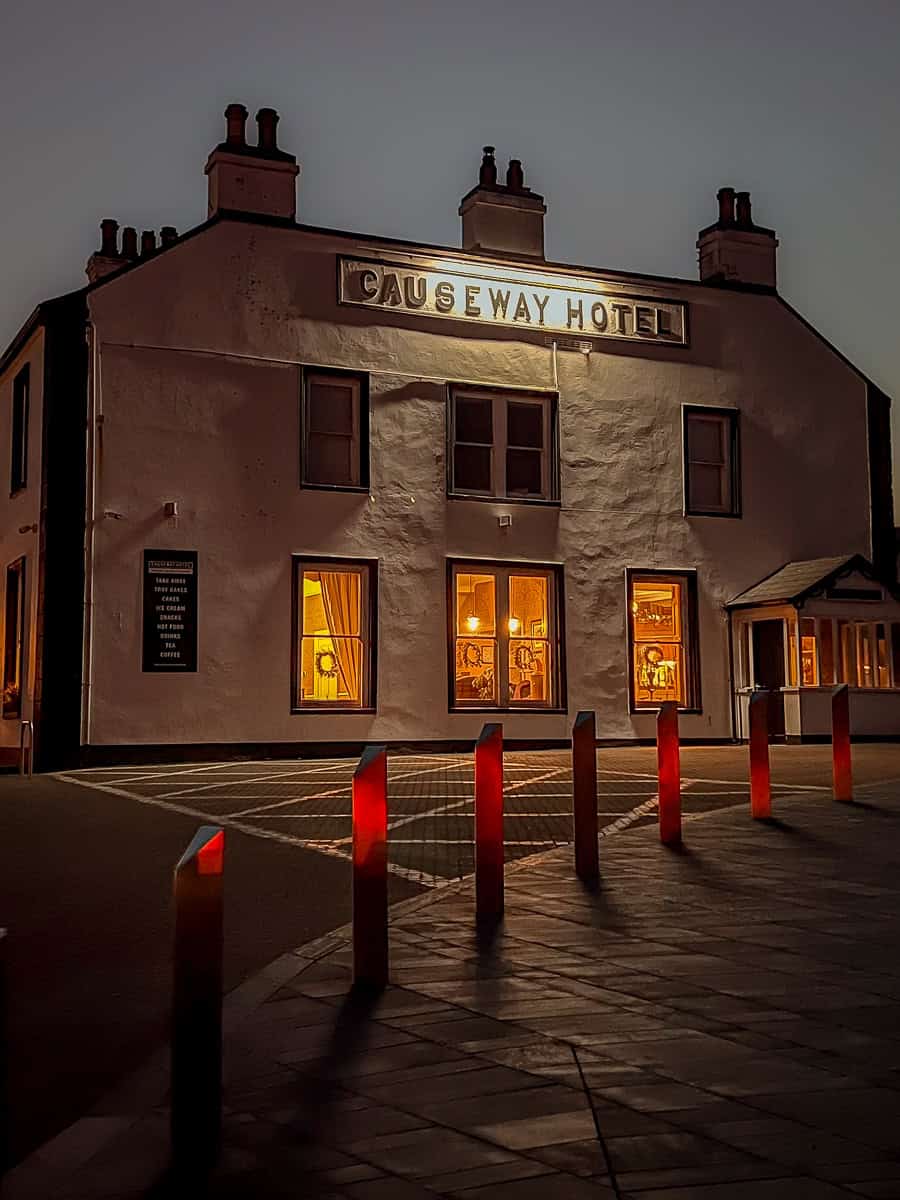
The best way to see the Giant’s Causeway at sunset is by spending the night at the Causeway Hotel next to the visitor centre.
With no ticket barrier, you can access the columns after hours and avoid the crowds.

9. Stay overnight at Causeway Hotel
Did you know you can stay overnight at the Giant’s Causeway? The Causeway Hotel is right next door to the visitor centre.
I had a lovely room overlooking the coast and woke up to a great full breakfast after my early morning walk down to the columns.
It’s a delightful place to base yourself to explore more of the Causeway Coast on a road trip.
They also have a cosy bar and restaurant for evenings. I loved a nightcap here after a chilly but magical sunset.

Is the Giant’s Causeway worth visiting?
Yes, the Giant’s Causeway is well worth visiting. It’s one of Northern Ireland’s most popular attractions for good reason: it’s utterly magical.
What could be more enchanting than admiring 40,000 hexagonal basalt columns that emerge from the wild ocean?
It’s also easy to visit from Belfast or as part of a road trip along the Causeway Coast.
Don’t skip a visit to the mystical Giant’s Causeway in Northern Ireland. It will leave you spellbound.


How long do you need to visit?
You could spend anything from 1-4 hours around the Giant’s Causeway; there is so much to do in the area.
For most visitors, two hours at the Giant’s Causeway is enough.
If you plan to pay to park at the visitor centre, there’s an insightful exhibition, gift shop, and tea room.
You can then walk/shuttle down to the coast to enjoy the basalt columns and head back.

Or, take an extended walk to the Amphitheatre, or walk along the clifftops, which takes 1-2 hours.
It really depends on the time you have, your physical ability and your interests.
I always try to spend the night at the Giant’s Causeway, as visiting at sunset is one of the most unforgettable experiences.


Top tips for your visit
- Wear sensible shoes to explore, as the walk down is a little steep. Also, columns are uneven and can be slippery after rain.
- You only pay for parking and entry to the National Trust visitor centre; you can visit the causeway anytime for free.
- If you plan to visit the visitor centre, book in advance, as parking slots sell out.
- It gets very busy during the day. I highly recommend sunset or getting up early for sunrise to avoid the mass crowds.
- A regular Giant’s Causeway shuttle runs from the visitor centre during operating hours for a small fee.

Explore the Giant’s Causeway Coast
You can combine plenty of magical destinations along the Causeway Coast with the Giant’s Causeway on a road trip.
You could visit Dunluce Castle, a magical ruined fortress on the cliffs, or Kinbane Castle, a hidden gem with fewer visitors.
Carrick-a-Rede Rope Bridge is an exhilarating experience thats an aerial walkway where you can cross over to a small island.


Ballintoy Harbour is a gorgeous fishing village that featured as the Lordsport of Pyke in the Iron Islands during Game of Thrones.
On that note, you can chase plenty of Game of Thrones filming locations around this area.
The most popular is the atmospheric Dark Hedges, or the Kingsroad. There’s also a ‘Game of Thrones Doors’ trail at popular pubs and hotels.


Recommended Travel Resources
–
Read my Northern Ireland guides
How to visit the Linen Hall Library in Belfast
How to visit the Mussenden Temple
Visiting the magical Armagh Robinson Library
Secrets of the Garvagh Pyramid
Discover the Crown Liquor Saloon in Belfast
How to visit the Glenarm Barbican

Discover Northern Ireland

Save how to visit the Giant’s Causeway for free