Is Beijing Summer Palace Worth Visiting in China?
⋆˙⟡♡︎ This post may contain affiliate links. Please see my disclosure policy for details. Thanks for your support ⋆˙⟡♡︎
Is Beijing Summer Palace worth visiting? I asked myself the same question while travelling through China.
It’s a Qing Dynasty complex on the outskirts of the city, farther from the main attractions. But that doesn’t mean it isn’t crowded every day.
However, many visitors don’t know the palace grounds open much earlier than the main museum attractions.
During this time, it’s a ghost town and an imperial paradise where you can enjoy a peaceful tour of the former royal grounds by Kunming Lake.
It ended up being one of my favourite experiences in China, and I’d do it again in a heartbeat.
Here’s a complete travel guide to visiting Beijing Summer Palace and whether it’s worth your precious travel time.

Beijing Summer Palace history
Beijing Summer Palace is China’s largest and best-preserved imperial garden, built from 1750 to 1764.
It was a royal retreat during the Jin Dynasty, but the Qianlong Emperor of the Qing Dynasty left the biggest mark. He built it as a gift for his mother.
It took 15 years to excavate the grounds to expand Kunming Lake, and tens of thousands of workers toiled to create Longevity Hill.
During the Second Opium War, British and French troops burned the grounds, which Empress Dowager Cixi later restored.
It suffered further damage in the crossfire of the Boxer Rebellion of 1900 and finally opened as a public park in 1924.
Today, it’s a UNESCO World Heritage Site visited by over 10 million people every year.


Is Beijing Summer Palace worth visiting?
Short answer: yes, it’s worth it. If you have the time to spare, go for it.
Long answer: Admittedly, I wasn’t going to visit after hearing how busy it gets with the number of tour groups that flood this place.
But when I found out I could visit the gardens early in the morning, I took the chance with both hands.
Strolling the Long Corridor and visiting the Huazhongyou complex before the crowds was such a magical experience. It was like a ghost town.
I know moody weather doesn’t appeal to everyone. But as a spooky girl, I was in my element. The dreamy fog was perfect.
Even if you can’t face an early wake-up call, this entire complex is a spectacular attraction that will leave you feeling enchanted.
I wouldn’t skip this incredible piece of Chinese history in Beijing. It’s like a portal that transports you back in time.
Things to do at Beijing Summer Palace
Here are the things to do at Beijing Summer Palace that make it worth visiting.
From strolling painted corridors to admiring a portrait pavilion, taking a boat ride and indulging in a traditional teahouse:

1. Long Corridor
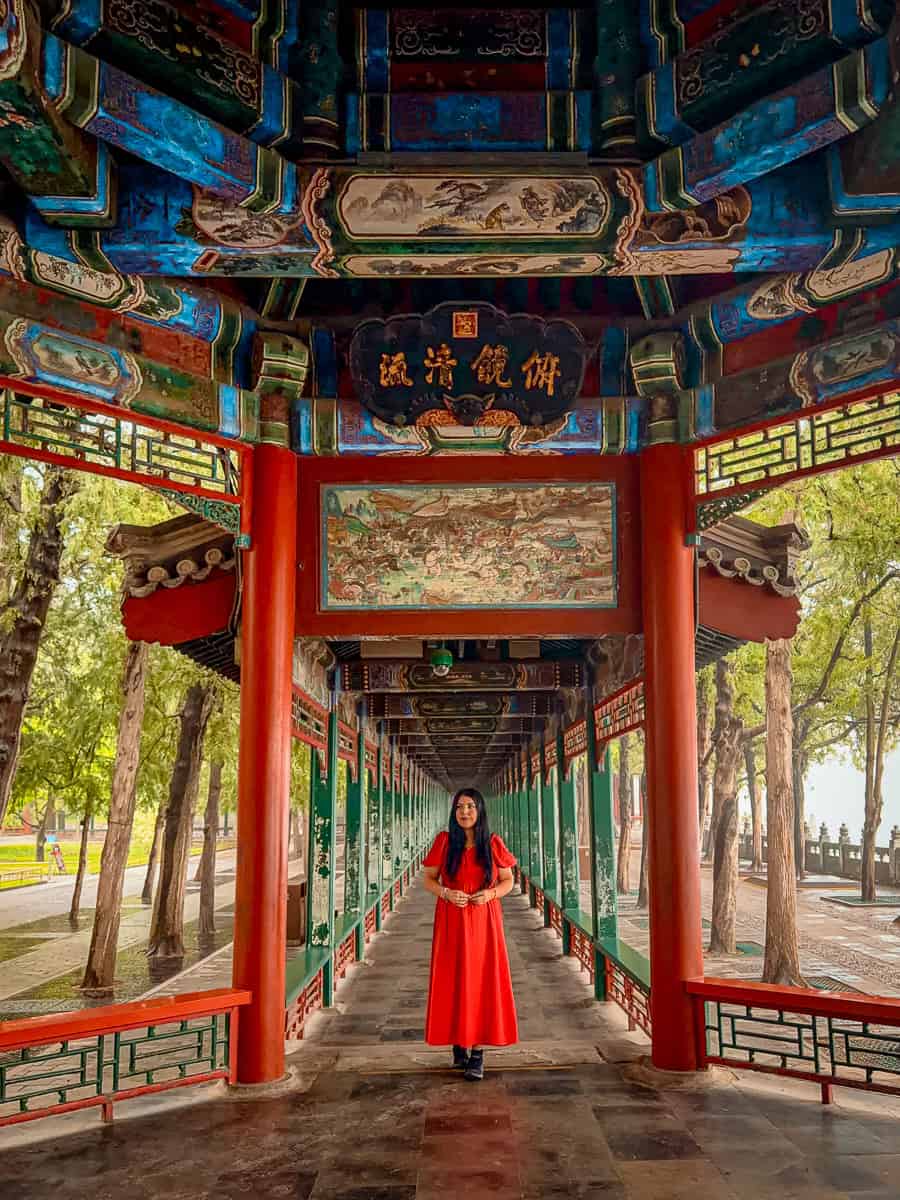
The Long Corridor was one of my favourite attractions: a 728-meter-long walkway that stretches along the banks of Kunming Lake.
It has over 14,000 colourful paintings and runs from the Gate for Greeting the Moon (Yao Yue Men) on the east side of the complex to the west.
In the middle, you’ll find the Cloud Dispelling Hall (Pai Run Dian), where Empress Dowager Cixi celebrated her birthday.
You’ll also find four resplendent pavilions that symbolise the seasons:
- Liu Jia (留佳亭) – Retaining the Goodness
- Ji Lan (寄澜亭) – Living with the Ripples
- Qiu Shu (秋水亭) – Autumn Water
- Qing Yao (清遥亭) – Clear and Far
Early in the morning, no one was around, and it was glorious. They even played classical music, and it felt like a portal to a bygone era.


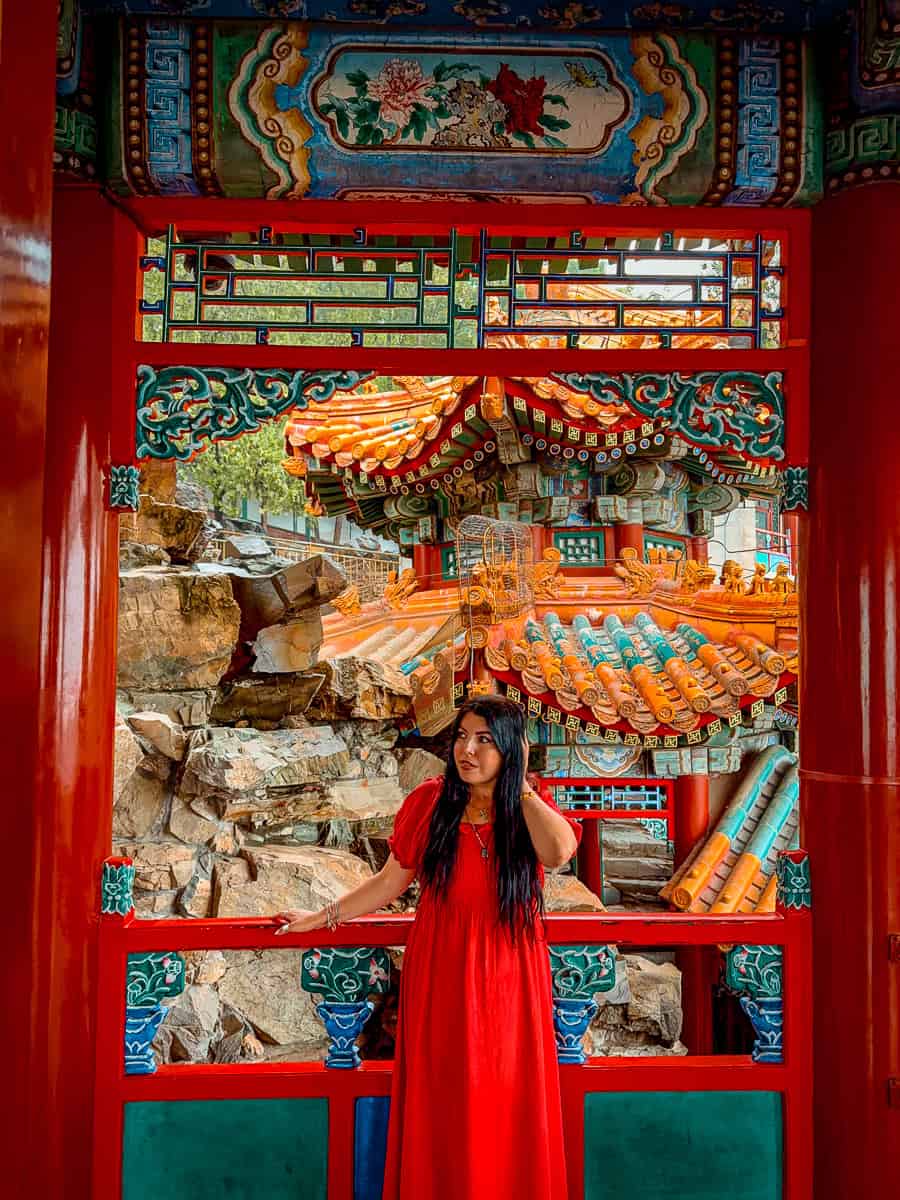
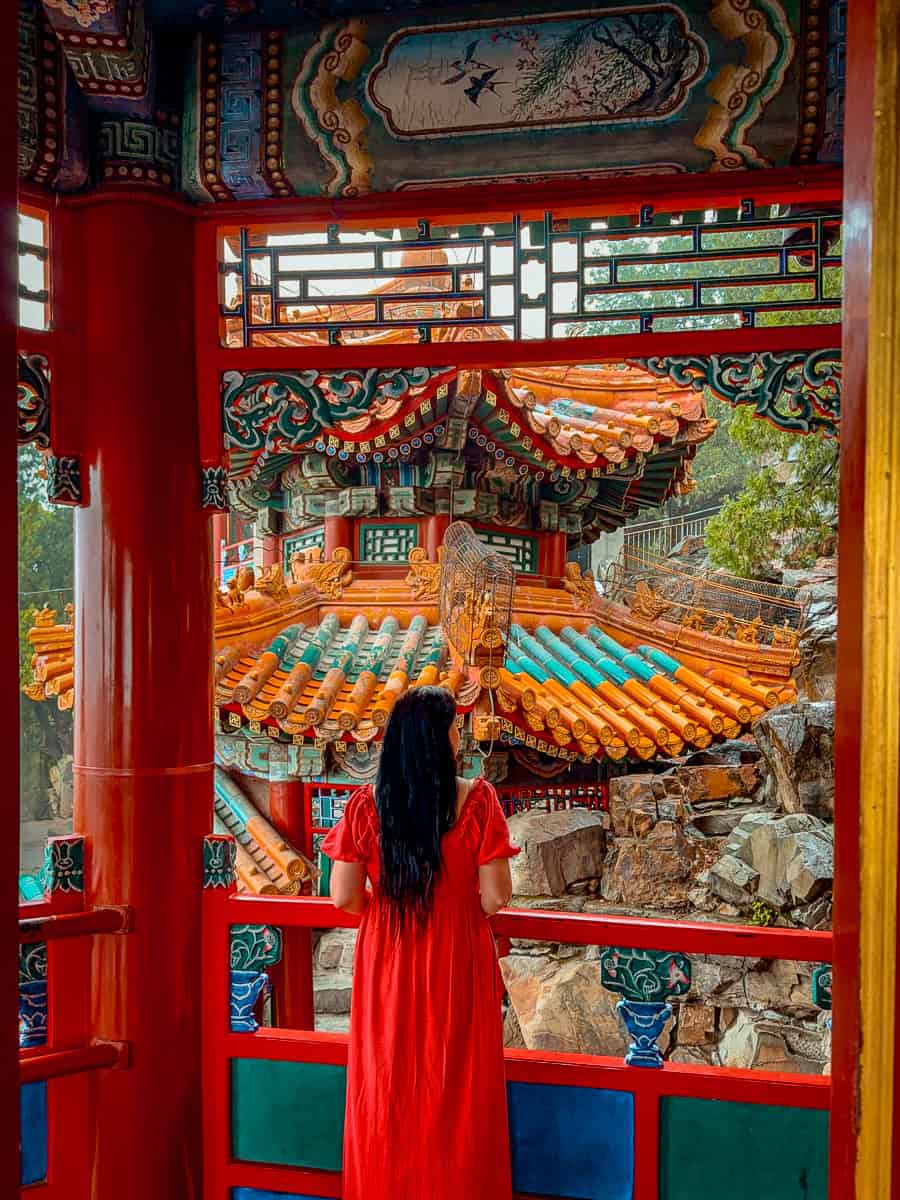
2. Huazhongyou (Travel in Pictures)
One attraction often shared on social media is a hidden gem at Beijing Summer Palace.
It’s called Huazhongyou (画中游), or “Travel in Pictures,” and was originally built in the Qianlong period after the Emperor had a dream.
The immersive scenery makes visitors feel like they are travelling through a portrait, hence the name.
This was easily my favourite part of the entire complex. It is such a gorgeous place for photos.
You cannot miss it. I could have honestly spent an age walking through this opulent set of pavilions. So many details are worth admiring.
3. Marble Boat of Purity and Ease
You’ll find the Marble Boat of Purity and Ease on the western side by the Long Corridor, where it serves as a lakeside pavilion.
The boat was first built of wood in 1755 but later burned down during the Second Opium War at Lord Elgin’s orders.
Empress Dowager Cixi ordered the restoration in marble in 1893. It was created to resemble a Paddle Steamer, but it’s permanently docked.
Boat rides do run from this wharf in the summer season if you want to admire this royal retreat from the water.


4. Tower of Buddhist Incense
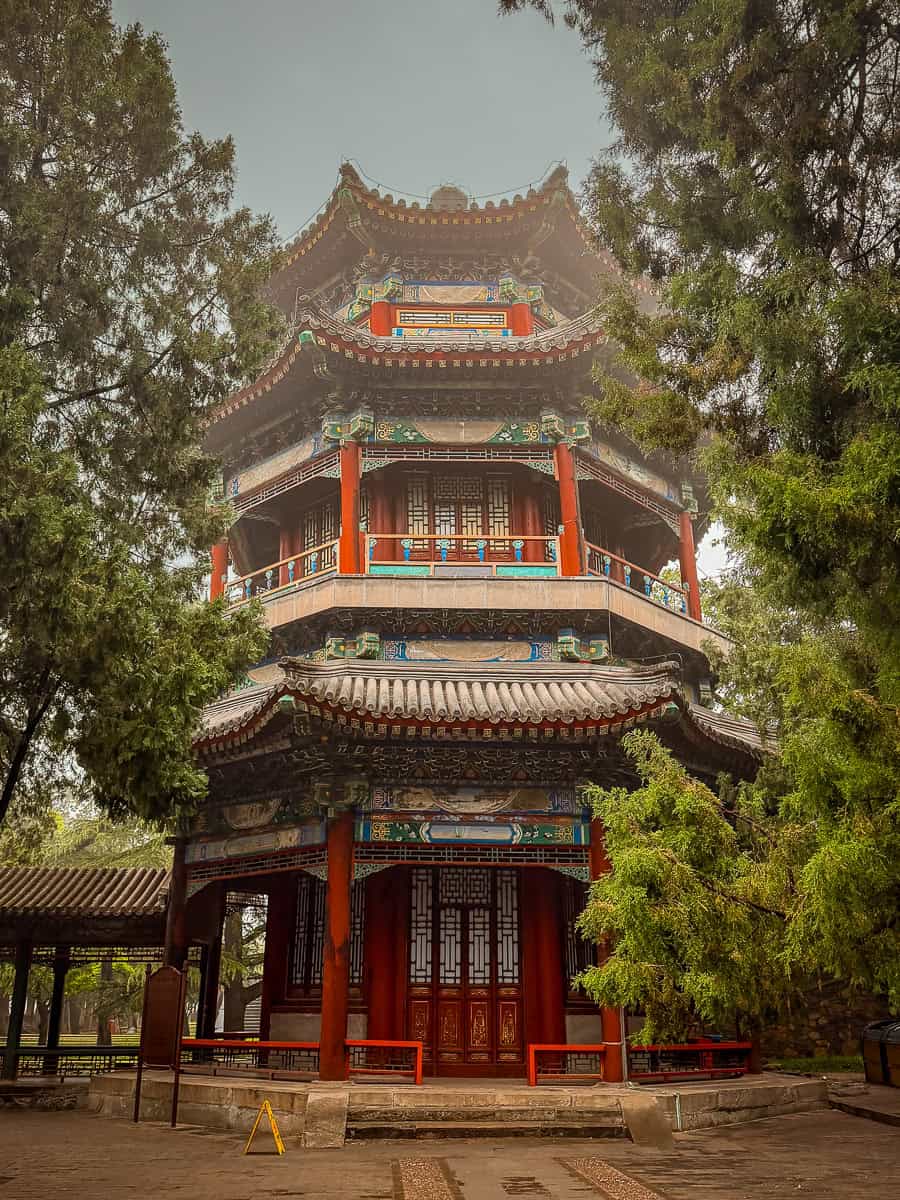
You’ll find the Tower of Buddhist Incense at the top of Longevity Hill in the heart of the complex.
This 41-metre-tall octagonal landmark houses the Thousand-Armed Avalokiteshvara and 45 Buddhist statues.
I didn’t go inside the Tower of Buddhist Incense because it required an extra ticket, and the tour group crowds looked overwhelming.
I was more than happy to catch glimpses of it while strolling along the Long Corridor and Kunming Lakeside.


5. Hall of Benevolence & Longevity
On the Eastern Side of the complex, you will visit the Houses of the Inner Court.
The first significant one you’ll see is the Hall of Benevolence and Longevity. It was built in 1750, but British troops destroyed it in 1860.
Empress Dowager Cixi later rebuilt it in 1888. But it still retains its original furnishings.
By then, the tour groups had descended, and it was hard to get a good look at Renshoudian without a scrum.
But I loved all the beautiful artwork, ideograms, and brass statues placed outside.
You can also visit the Hall of Jade Ripples (Yulangtang), a decade-long prison for Emperor Guangxi during the 1898 Reform Movement.
Also, stop by the Hall of Joyful Longevity (Leshoungtang), the private residence of the Empress Dowager Cixi.


6. Kunming Lake
After touring the halls, you can escape the main tourist circuit and head to the lakeside.
A gorgeous scenic pathway leads you around Kunming Lake on a flat path.
It was raining on my visit, so it was foggy, and the views weren’t great. But a small pier provides lovely views of Longevity Hill.
There are normally boat rides from here, but due to the low visibility, they were cancelled on my visit.


7. Seventeen-Arched Bridge
I could also see the picturesque Seventeen-Arched Bridge in the distance. It’s 150 metres long and 7 metres wide.
You can walk across the bridge and look out for the 544 carved stone lions along the railings.
The views from this bridge are perfect at sunset on a clear day, when you can watch the sky change colours.
Near the winter solstice, the low sun shines directly through the arches, creating a natural light display.

8. Zhichun Pavilion Tea House
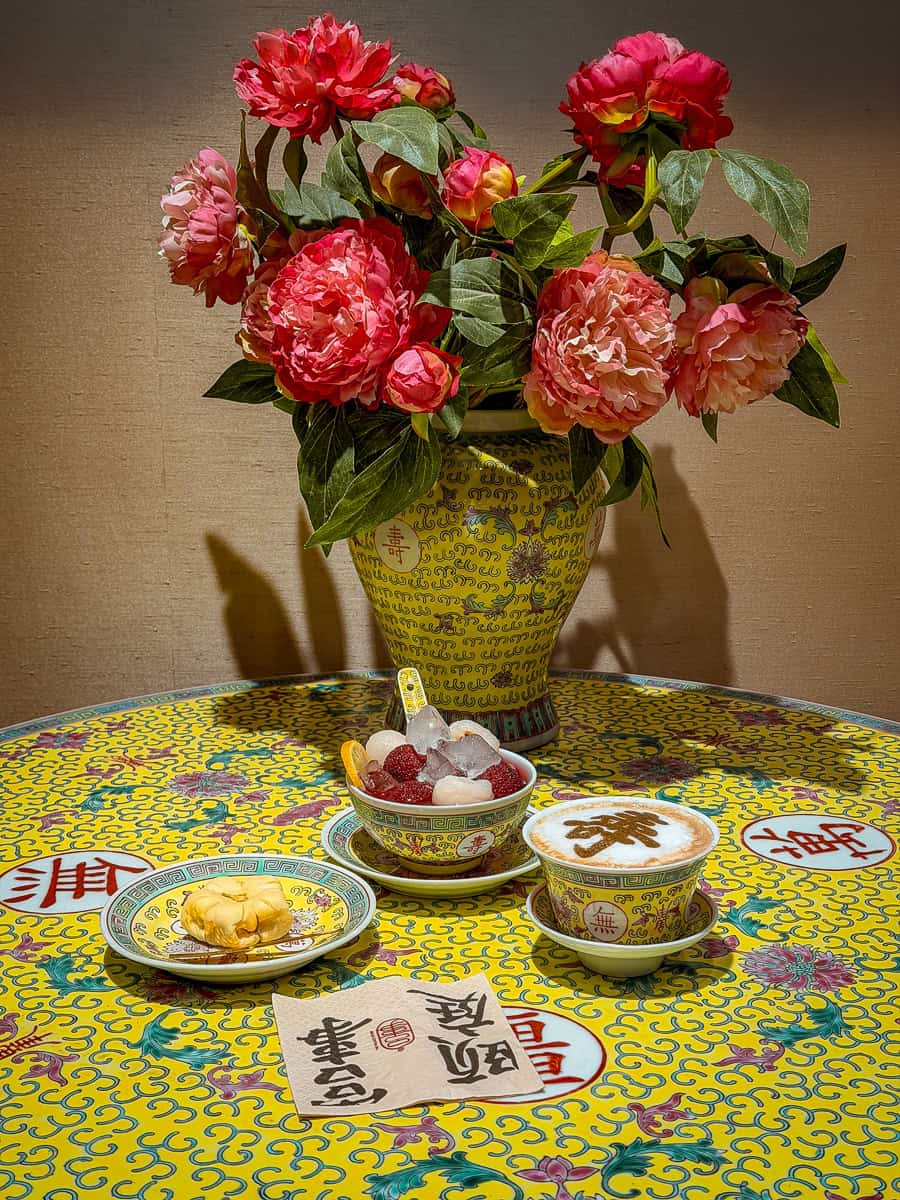
If you want to feel like Chinese royalty for a spell, then pop into the Zhichun Pavilion Tea House.
You’ll be transported back to the Qing Dynasty, where you can enjoy glorious drinks and desserts.
You’ll sit on ancient vase stools and be served high tea in fine china. There’s seating both inside and outdoors.
I particularly enjoyed my iced lychee dish, and I loved that my cappuccino had calligraphy on the foam.
It was the perfect tonic on such a damp and chilly day, and the staff were so lovely. It’s something you must experience.


How to visit Beijing Summer Palace
Beijing Summer Palace is located 15 kilometres from central Beijing in the western suburbs. It’s a 30-45 minute drive depending on traffic.
As Google Maps doesn’t work in China, I recommend downloading Amap. The Summer Palace can be found by searching ‘颐和园’.
East Palace Gate (东宫门) will be the busiest as it’s closest to the Inner Halls.
I recommend entering via the West Palace Gate (颐和园西门) near the Long Corridor and working backwards.
It’s near the Summer Palace West Gate Station on the Xijiao Line of the Beijing metro. You can download a travel card through Alipay.
Or, you can order a DiDi (Chinese Uber) through Alipay to save time. Trips are very affordable.

The address is 19 Xinjian Gongmen Road, Haidian District, Beijing 北京市海淀区新建宫门路19号

Opening times and prices
Beijing Summer Palace grounds are open from 6 am to 8 pm daily (April to October). Hours differ in winter and on national holidays.
The Tower of Buddhist Incense and other museums won’t open until 8 am.
If you want to avoid mass crowds, I recommend getting up early for the 6 am opening. It’s tiring, but worth it for the almost empty gardens.
Ticket prices for the Summer Palace change with the seasons, but it’s typically 30 RMB for a basic grounds ticket. This is what I bought.
You will need a combined ticket (60 RMB) if you also want to visit the Tower of Buddhist Incense, Garden of Virtue and Harmony, etc.


When is the best time to visit?
There isn’t really a ‘bad’ time to visit Beijing Summer Palace. Despite the name, it’s a gorgeous attraction year-round.
However, it does get incredibly busy with tour groups, so I recommend visiting the gardens very early in the morning.
It opens at around 6 am, and this is the best time to visit for photography. It’s gloriously quiet until around 8 am.
After the Tower of Incense opens, it’s carnage. So, I only bought a garden ticket for this reason.
Avoid visiting on national holidays like Chinese New Year (Feb), Golden Week (Oct), or Labour Week (May), as the crowds are tenfold.


How long do you need to visit?
I recommend scheduling at least 2-3 hours to visit the Beijing Summer Palace, maybe more if you have a particular interest.
The complex is vast, and there is a lot to see and do here. Even though I didn’t enter the tower, I still spent over three hours in the gardens.
Also, consider how long it will take to travel here from central Beijing. It’s in the western suburbs, much farther from the main attractions.


My top tips for visiting
- Wear comfortable shoes as you’ll be doing a lot of walking around the site.
- The area around the Long Corridor and Kunming Lake is flat, but the Hall of Incense and Huazhongyou are accessed via steep hills and steps.
- To avoid crowds, I would visit this place as soon as it opens at 6 am. It gets ridiculously busy during the day with tour groups.


- If you can’t avoid your entry time, enter via West Gate to avoid queues and work ‘backwards’ toward the halls near the East Gate.
- Plenty of tea rooms and cafés around the site offer refreshments, plus there are clean, sit-down toilets (no squatting today, yay).
- Do not travel to the Summer Palace during a national holiday. It will be traumatic. I’m not exaggerating; even locals warn against it.
Recommended Travel Resources
–
Read my China guides
How to visit Pop Land in Beijing
How to visit the Temple of Heaven in Beijing
Is the Tianjin Binhai Library worth visiting?
Apoli Itabakery – is this fairytale cafe worth visiting?
13DE Marzo – visit a teddy bear café in Shanghai
Is No. 3 Warehouse in Shanghai worth visiting?
How to Visit 1000 Trees in Shanghai
Yuyuan Gardens Shanghai – Demon Slayer Infinity Castle
1933 Old Millfun – Brutalist Labyrinth in Shanghai
How to visit the Tower of Life at SKP Chengdu
How to visit the Dujiangyan Blue Tears
How to visit Dujiangyan Zhongshuge Bookstore

Discover China
Save Beijing Summer Palace for later