Kathakali Dance in Kerala – What is it? & How to Watch a Show
⋆˙⟡♡︎ This post may contain affiliate links. Please see my disclosure policy for details. Thanks for your support ⋆˙⟡♡︎
Kathakali Dance in Kerala was the number one thing I wanted to do on my trip there.
It had been on my bucket list forever, and I was so excited to finally watch a performance.
Kathakali is an ancient form of religious dance based on Hindu epics like the Ramayana.
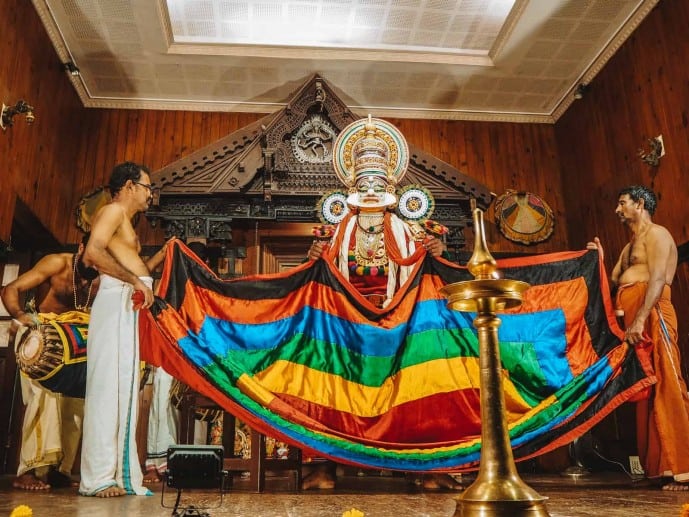
It takes six years of practice to perform it. You also study tirelessly to play the music and apply makeup.
Watching a Kathakali performance is a must-do in Kerala. But you need to know a few things before booking a show.
Keep reading for a guide to booking a performance and what to expect.

1. Kathakali is an ancient religious practice
The art of Kathakali as we know it today has been around since the 16th and 17th centuries, but its origins go much further back.
Some say it originates back to ancient Sanskrit texts, like the Natya Shatra, from 200 BC.
But others claim it dates back 1500 years to ritualistic folk dances in South India.
Either way, records show that the Zamorin Raja of Calicut wrote Krishnagiti, based on the life of Krishna, in the 17th century.
It mixed ancient Sanskrit ritual dances, where performers mimed the story, and musicians narrated it.
Back then, only royalty could watch it in temples and palaces. Over time, this dance was shaped into the practice we see today.
They performed it at religious festivals in temples, and the performances lasted for days. They also perform for tourists.

2. Kathakali takes years of study
If you studied Kathakali at one of the top-rated Kathakali centres in India, like Kerala Kalamandalam, you wouldn’t graduate for 7 years.
It takes years to practice, so when you watch the performers on stage, you know they gave so much of themselves to perform it.
They say that there are five elements to Kathakali;
- Natyam (Acting)
- Nrithyam (Expression)
- Nritham (Dance)
- Sangeetham (Music)
- Chutti (painting or makeup)
All of these elements need to be mastered, whether you’re a dancer, musician, or makeup artist.
So, you need to be pretty dedicated and know this will be your long-term career.

3. Kathakali can go on all night in festivals
The main reason why people have mastered Kathakali through the centuries is that they wanted to perform it during religious festivals.
Years ago, when this dance was performed, it was based on stories from the Ramayana or Mahābhārata, both epics about Krishna’s life.
People believed that performing shows about Krishna and reenacting his journey would help them form an attachment and connection to him.
So, even today, during festival times, Kathakali performances go on all night, sometimes reenacting endless chapters of the tale.

4. Kathakali makeup can take hours to apply
When you watch a cultural show while in Kerala, you’re only watching a fraction of traditional dance.
During an official performance, the makeup process takes well over three hours.
But during the one you’ll watch, the whole performance will take two hours.
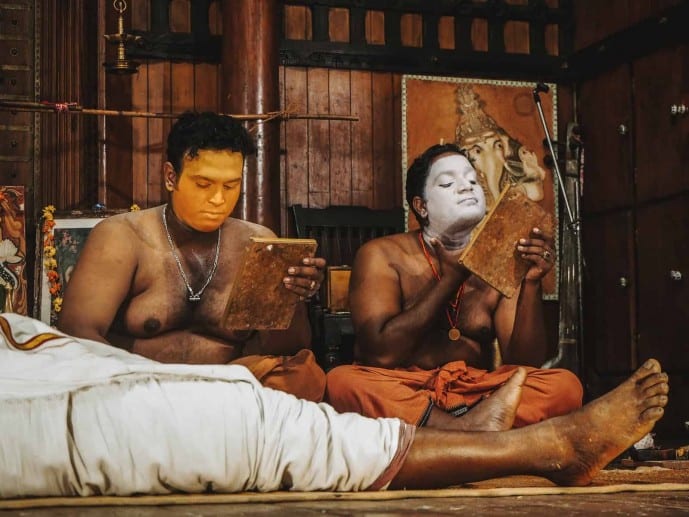
The first hour is watching the artists apply makeup, which is an art in itself.
Most of the actors in the show I watched applied their own makeup, except the Pacha, who has a green face.
He needed extra work from a makeup artist (called a Chuttikkaran) to apply the white face enhancements on the side.
Although many find this part boring, I was captivated.

How do they make Kathakali Makeup?
During the show, we also learned that many of the makeup ingredients are organic:
- Base: coconut oil
- Yellow and red paint: powdered stones
- White paint: lime and rice flour
- Black paint: gingelly oil
- Green Paint: Manayola and Neelam
Some actors are so dedicated to their work that they put flower seeds in their eyes to make them go red. It creates a sinister look.

5. The dancers communicate using their bodies
While you’re watching a Kathakali Dance in Kerala, you may be a little confused about how it is performed.
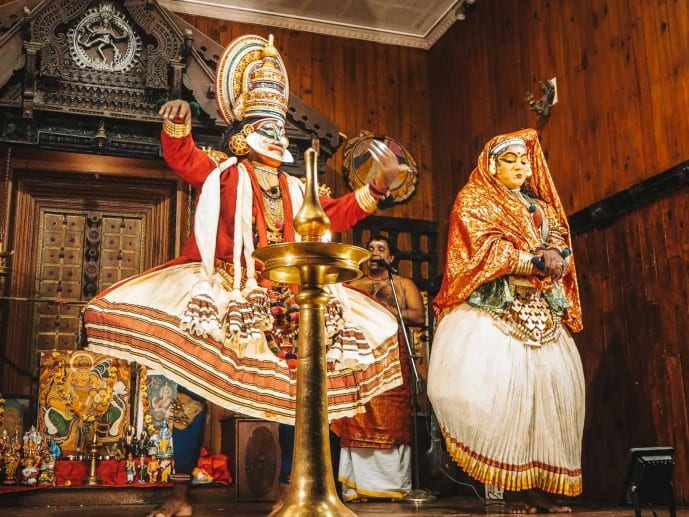
There is no talking at all, only dancing through a series of movements.
The actors learn thousands of unique expressions and movements which create a language on the stage.
A slight eye movement, eyebrow twitch, flick of the wrist, or foot angle can communicate something different as part of the plot.
But don’t worry, with most shows, you’ll be given the plot of the performance they are about to perform beforehand.

In the show I watched, they even gave us examples of movements used for a speech before it started.
Like shaking your head at different speeds to say “no” or “get out,” or moving your cheeks and eyes to signify love or lust.
That way, it made a lot more sense while we were watching the dancing. It was gripping to see it in practice along with all the drums and music.
I cannot imagine how much concentration and effort it takes to remember all the moves for the performances.
But I guess that’s why they study for years to master it.

6. You can watch a Kathakali Dance all over Kerala
If you’re interested in watching a performance while you’re here, you can find them all over Kerala.
So, there isn’t one particular place to watch it. They perform in hotels, near the beach, and at cultural centres all across the state.
The best place to catch a performance is in the cultural hub of Fort Kochi.
It’s the perfect place to watch it, as it really adds to the experience of Kerala’s history.
I watched a performance at the Kathakali Cultural Centre. I highly recommend booking early as performances do sell out.
Also, if you’re interested in other performances, the cultural centre offers a wide range of shows daily.


7. Try a Kathakali workshop
Of course, mastering Kathakali takes years of practice, but you can get a taster at the Kathakali Cultural Centre.
They run small private classes for one day, up to longer, more intensive courses that run for weeks.
If I’d had more time in Kerala, this would have been right up my street, as I love trying new things, but unfortunately I was on a tight schedule.

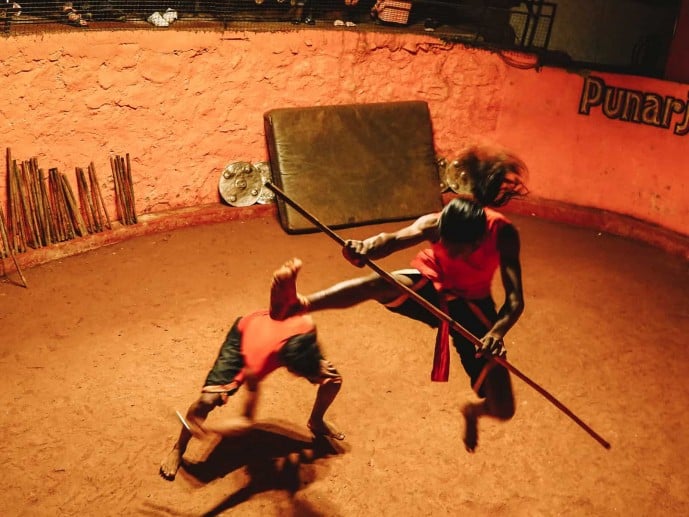
Watch a Kalaripayattu performance
If you loved Kathakali Dance in Kerala, another cultural performance you may want to watch while you’re there is Kalaripayattu.
This ancient martial art originated with Kerala’s warriors centuries ago.
Mastering Kalaripayattu takes years, and some train from childhood until old age.
I watched a performance in Munnar and was absolutely captivated.
During the show, we watched the warriors fight with wooden sticks and swords, using shields.
Looking for more travel inspiration for Kerala?
I spent a week here in Kerala and absolutely loved it. So, I’ve written some detailed guides about all my adventures here.
Be sure to read my travel guides from the historic Fort Kochi and the hill station of Munnar to the backwaters of Alleppey:

Related Post: How to spend One Week in Kerala
Recommended Travel Resources
–
Read my Kerala guides
The best places to visit in Munnar
The top attractions in Fort Kochi
The best Tea estates in Munnar
The best sightseeing from Cochin to Munnar
Chinese fishing nets: How not to get scammed!
A complete road trip to Munnar guide
Top Station: is the drive worth it?
Discover India

Save this Kathakali Dance guide for later


Heads up: India Someday sponsored my trip to Kerala. They are an awesome company that can plan your trip to India. Click here to read my full review of their service!