Duchess Anna Amalia Library in Weimar – Breathtaking Baroque Book Trove!
⋆˙⟡♡︎ This post may contain affiliate links. Please see my disclosure policy for details. Thanks for your support ⋆˙⟡♡︎
If you are a reading lover then you must add the stunning Duchess Anna Amalia Library to your bookish bucket list.
The awe-inspiring Rococo Hall is the jewel in its crown that boasts a wealth of Romantic and Classicist books and portraits.
It’s somewhere that every bibliophile will be smitten with but a fair warning, gentle reader. Visiting this Baroque beauty is restricted.
Entry is limited to just a few hundred people per day so you’ll need to book your tickets well in advance to guarantee entry. Or, you can take a chance.
Here is a complete guide for visiting the Duchess Anna Amalia Library in Weimar, a breathtaking book trove in central Germany.

History of the Duchess Anna Amalia Library
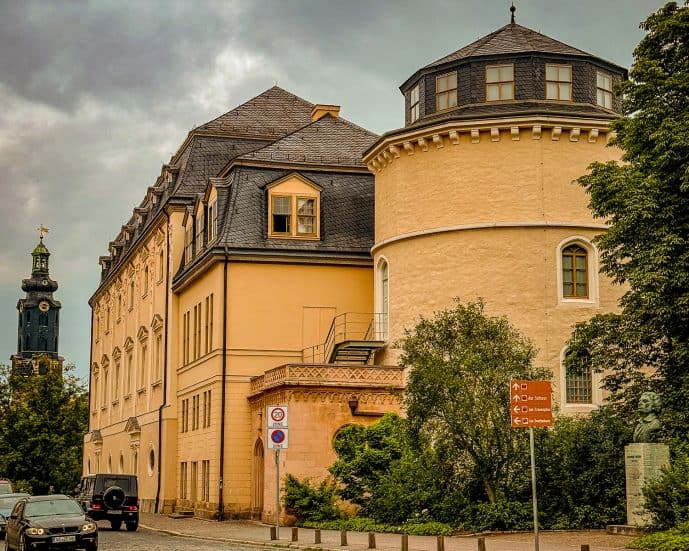
The library is located inside a historic building known as the ‘Green Castle’ and it was built by Nikolaus Gromann in 1562.
It was converted into a library at the behest of Duchess Anna Amalia of Saxe-Weimar-Eisenach in 1761.
After the death of her husband, she assumed responsibility for the duchy until her son came of age in 1775.
As a huge patron of the arts and a composer, the duchess used to gather poets, musicians and scholars in her court at the Wittum Palace known as the Court of Muses.
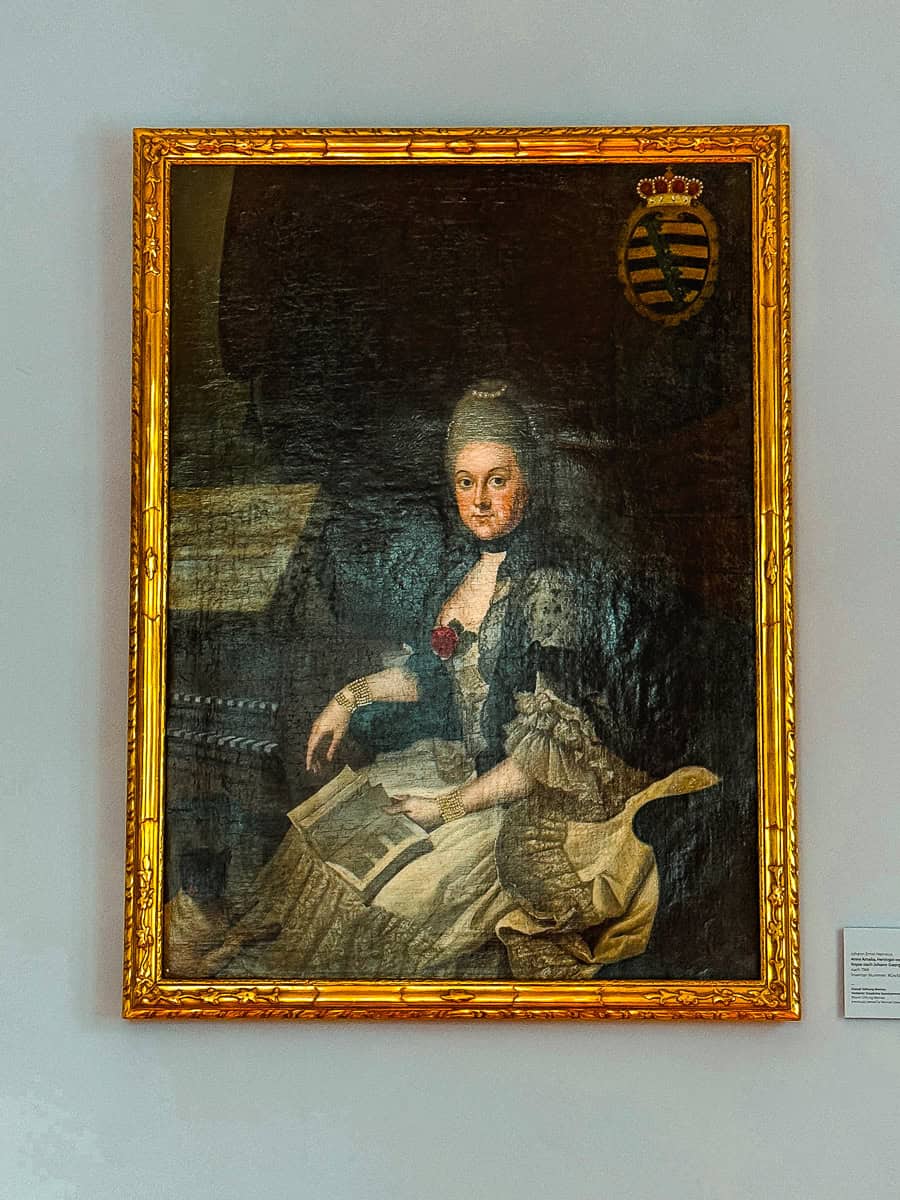
Anna Amalia also played a large role in establishing Weimar Classicism. She is honoured in Goethe’s Zum Andenken der Fürstin Anna-Amalia.
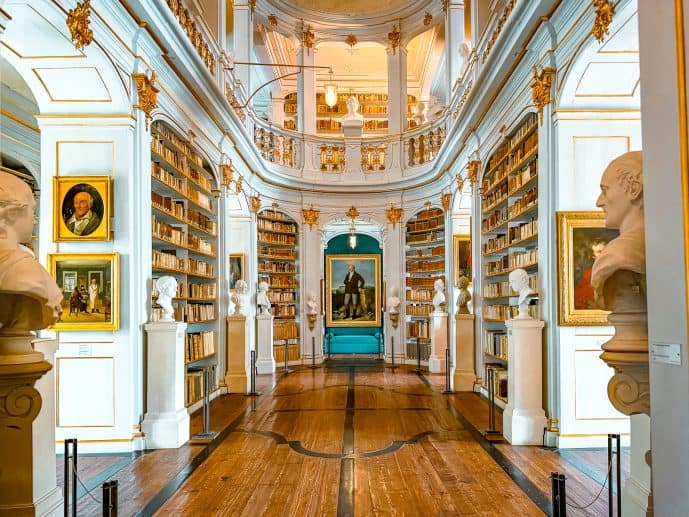
In 1766, a three-storey Rococo Hall was constructed inside the Green Castle and Anna requested that the court book collection be moved there.
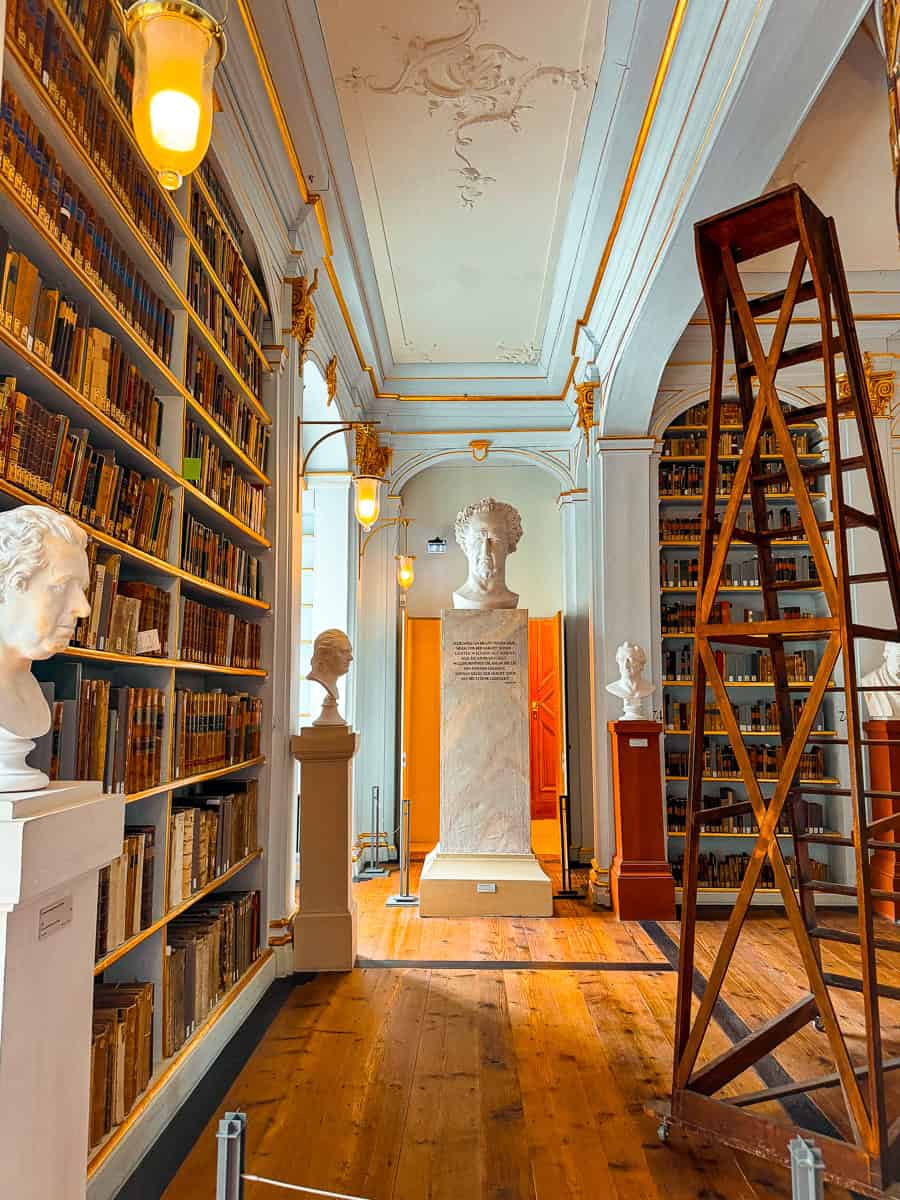
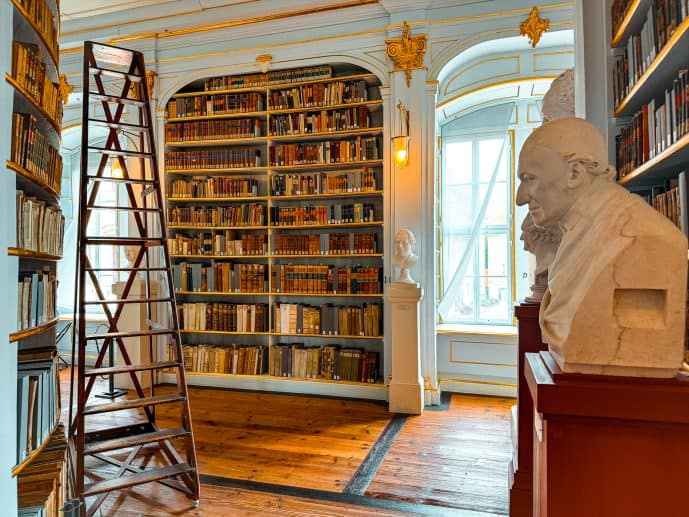
Alongside some 40,000 volumes, there are portraits and busts of the ducal family along with great writers such as Goethe, Herder and Wieland.
It’s now one of the important sites of German Classicism in Weimar and forms part of a UNESCO World Heritage Site.
Destruction & Reconstruction
Unfortunately, the Rococo Hall faced a devastating fire in 2004 and much of the library and its contents were destroyed.
It immediately underwent an extensive reconstruction project to salvage it.
The work took three years to complete and the library finally reopened to the public in 2007.
These impressive conservation efforts ensured that the library was well protected and remained accessible to the public for future generations.
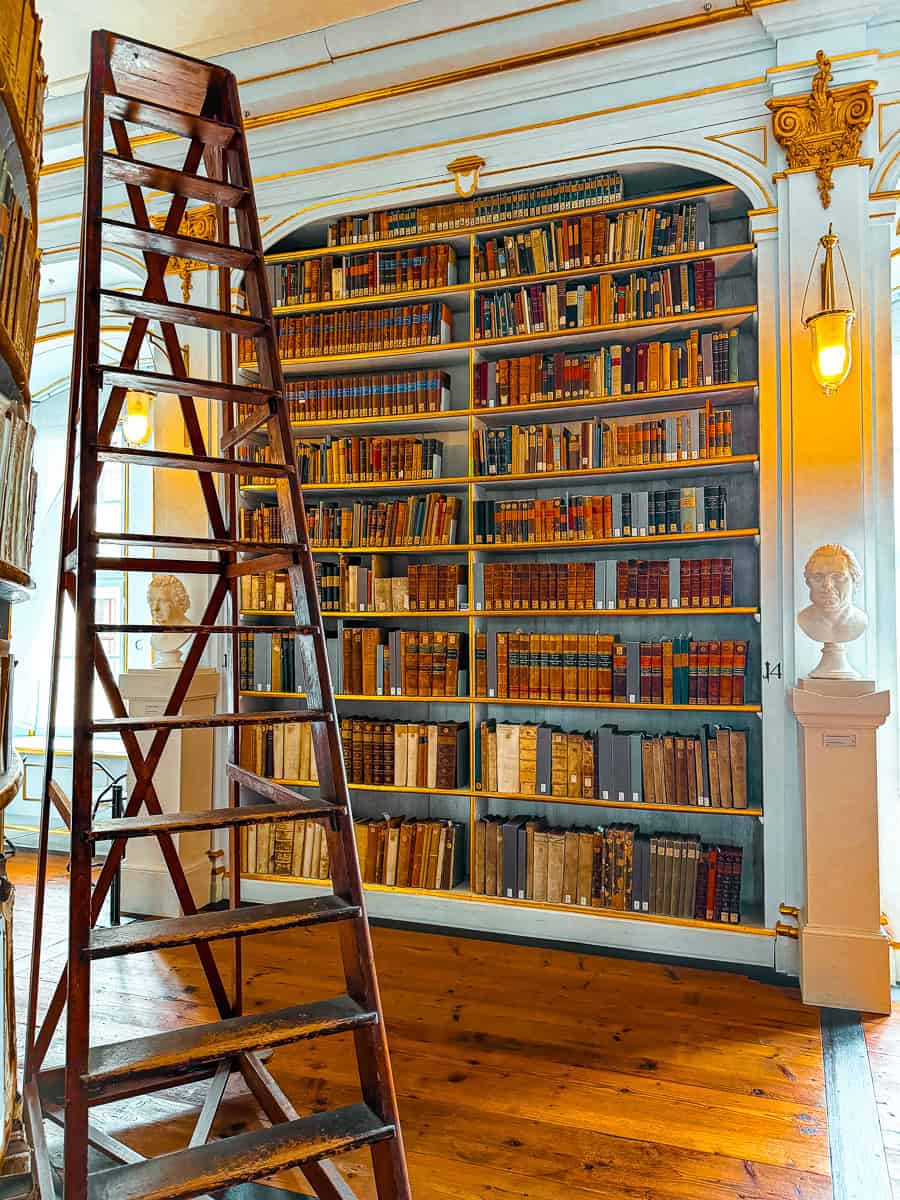
Can you visit the Herzogin Anna Amalia Bibliothek today?
Yes, you can indeed. Reading lovers will be happy to know that this stunning Rococo Hall is a museum you can visit in Weimar today.
The library receives well over 100,000 visitors each year but entry is restricted as they cap the number of visitors allowed inside per day.
So, if you were set on visiting this Baroque book trove, it’s best to plan your visit well in advance.
The great news is that Weimar is the perfect trip for literary lovers as the entire city is littered with bookish attractions.
How many people can visit the library per day?
It’s important to know that visitor numbers to the library are capped at around 300 people per day for conservatorial reasons.
There are also only a few time slots available. So, tickets can sell out pretty quickly online.
I would book your tickets as far in advance as you are able as it’s one of the most popular tourist attractions in Weimar.
If you are unlucky enough to find that advanced tickets have sold out for the day of your visit like me, don’t fret.
You still have a chance to snag one of the 50 tickets that they sell on the day, subject to availability.
That being said, I would make sure to get here for opening time as there is usually a queue at the door with other hopeful visitors!
Willkommen in Deutschland and Happy Hunger Games. May the odds be ever in your favour.
How to get to the Duchess Anna Amalia Library in Weimar
The Herzogin Anna Amalia Bibliothek is located in the city of Weimar. This is in the state of Thuringia which is central Germany.
Weimar isn’t the first city tourists think of when visiting the country but it’s a very underrated literary destination and worth checking out.
I visited Weimar on a day trip from Eisenach but you can also visit on a day trip from the cities of Leipzig and Dresden.
If you’re taking the train, you can alight at Weimar Hauptbahnhof and walk twenty minutes through the historic centre and Market Square to the library.

The library is located in Platz der Demokratie (Democracy Square). Click here for a Google Pin!
Opening hours and ticket prices
The library is open every day of the week except Mondays and typically from 9 am – 6 pm.
If you are hoping for a ticket on the day, I recommend showing up a little before opening and waiting in line.
I had my heart in my throat while queuing as I travelled an hour by train from Eisenach to visit and this is the attraction that drew me to Weimar.
Thankfully, I managed to buy my ticket easily as I was 5th in the queue.
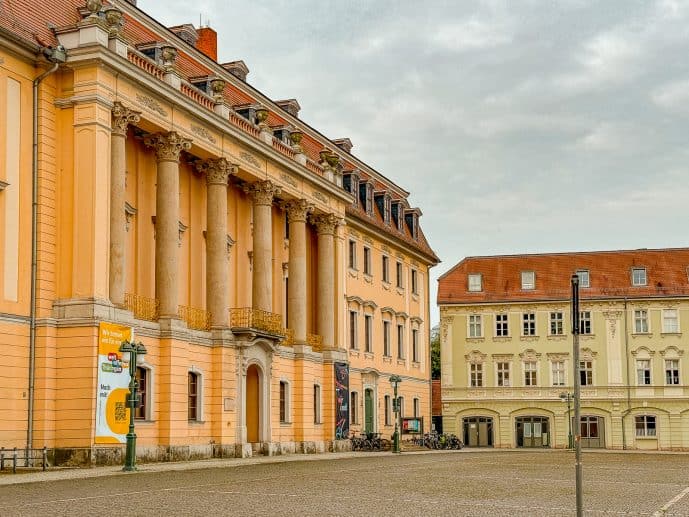
I was so surprised though at how many people showed up early in the morning to visit a library.
It made my bookish heart happy to know that people still love and respect the written word.
In a world of modern technology where everything is digitalised, many of us were willing to lose sleep and queue to enter this beloved book shrine.
Tickets for the library cost €8 for an adult and €6 for reduced. Students from 16-20 can also get inside for €3.
They also have a combination ticket where you can visit the Cranach Gallery. I highly recommend doing this as it’s a magnificent exhibition.
Entering the library
Once I finally bought my precious entry ticket to the library from the cash desk, I then made my upstairs to the library.
I was buzzing with anticipation and wanted to head straight inside.
But, this is Germany, and there are always rules about luggage and footwear to be dealt with first.
All bags have to be stored in their locker room. The lockers require either a one or two-euro coin that will be returned to you.
You also have to put on some pretty garish grey slippers to protect the floor. I have very small feet so these felt clogs drowned me.
I had to glide like I was ice skating and waddled like a penguin the entire visit. Not very graceful but it was pretty hilarious, haha!
Library treasures
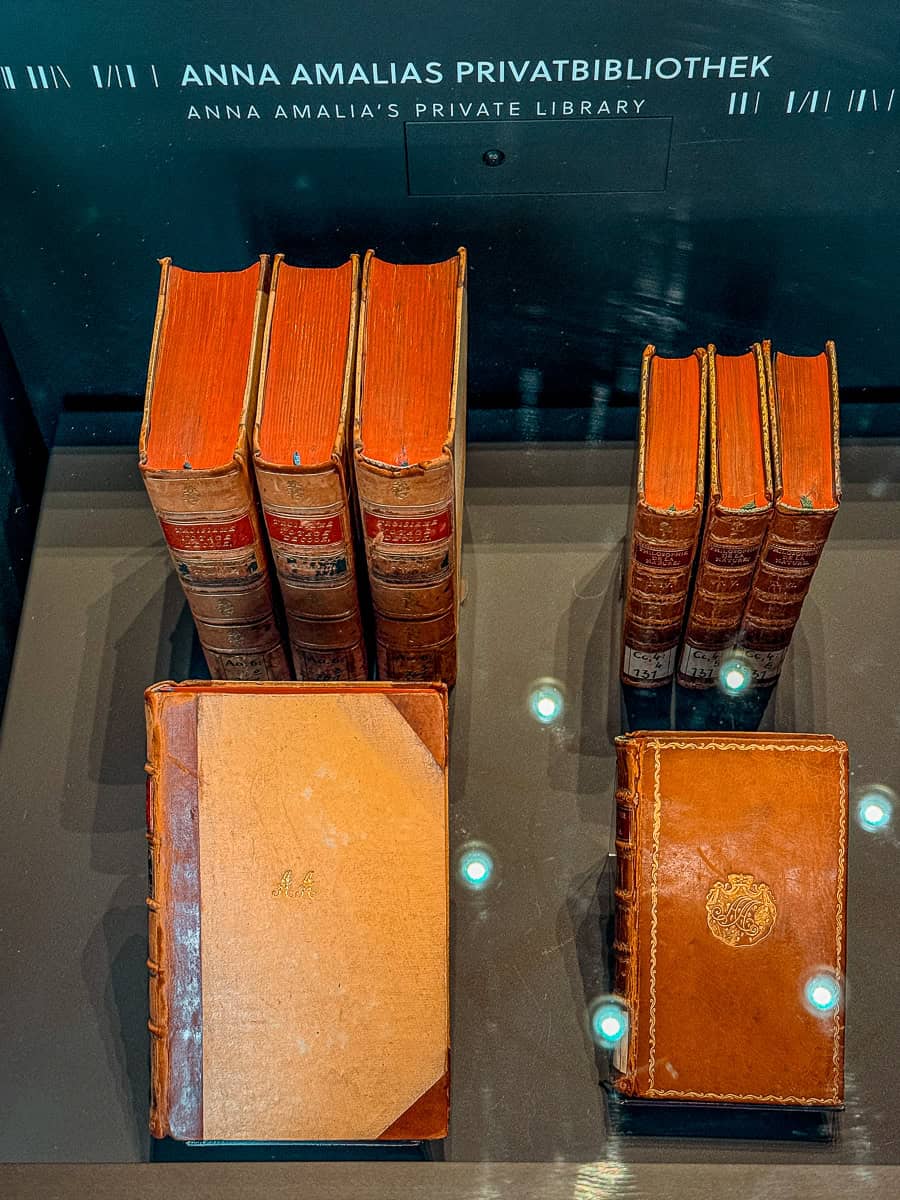
The first room I passed through on my tour was a library treasures exhibit which has some of their most precious tomes on display.
These books in the cases change often but they contain gorgeous pages with etchings you can fawn over.
On my visit, they had some of Duchess Anna Amalia’s private library on display.
These books were custom-made with her initials embossed on the covers and spines.
How dreamy, a library filled with personalised book covers is now what I aspire for!
It’s good to note that all the thousands of tomes at this library aren’t just museum exhibits left on the shelves to gather dust.
On special request, you can sign in and have a chance to read some of these volumes!
Rococo Hall
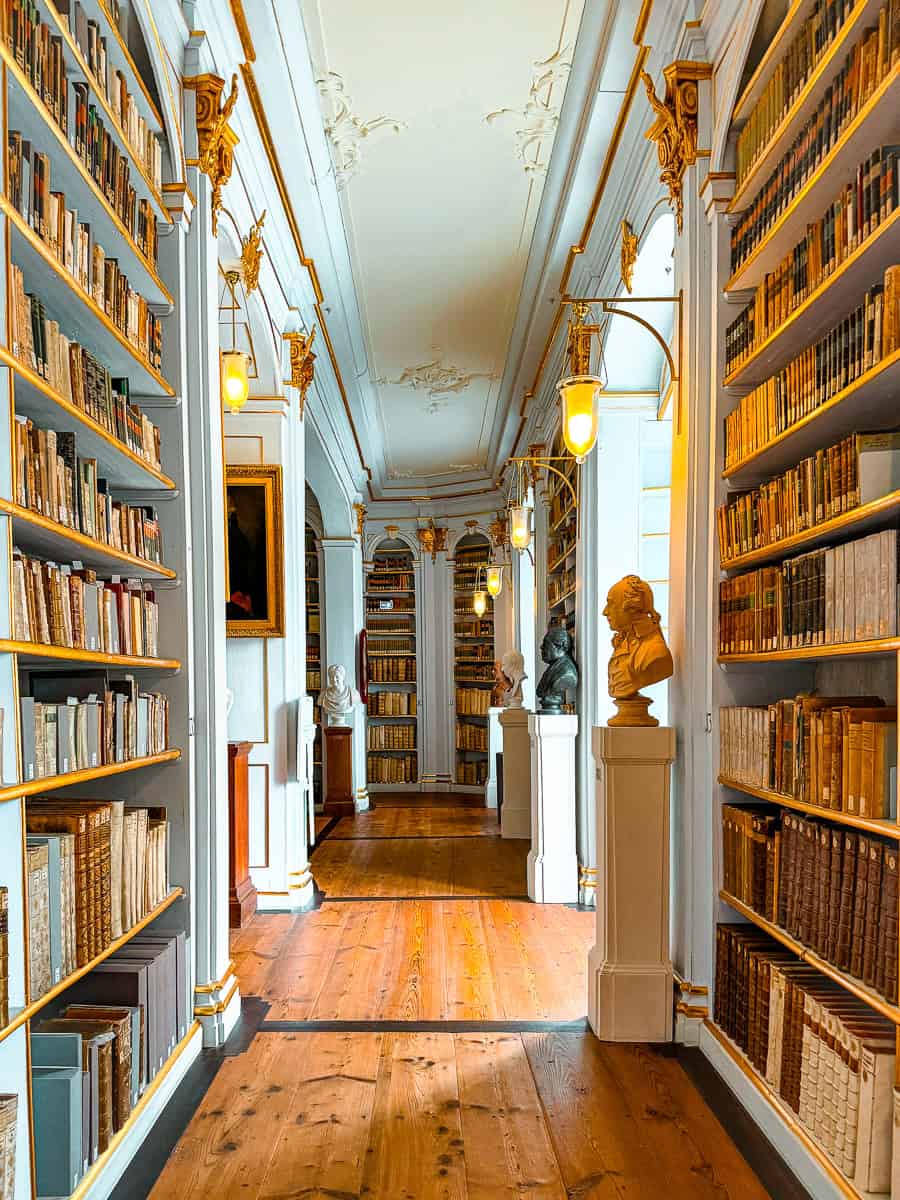
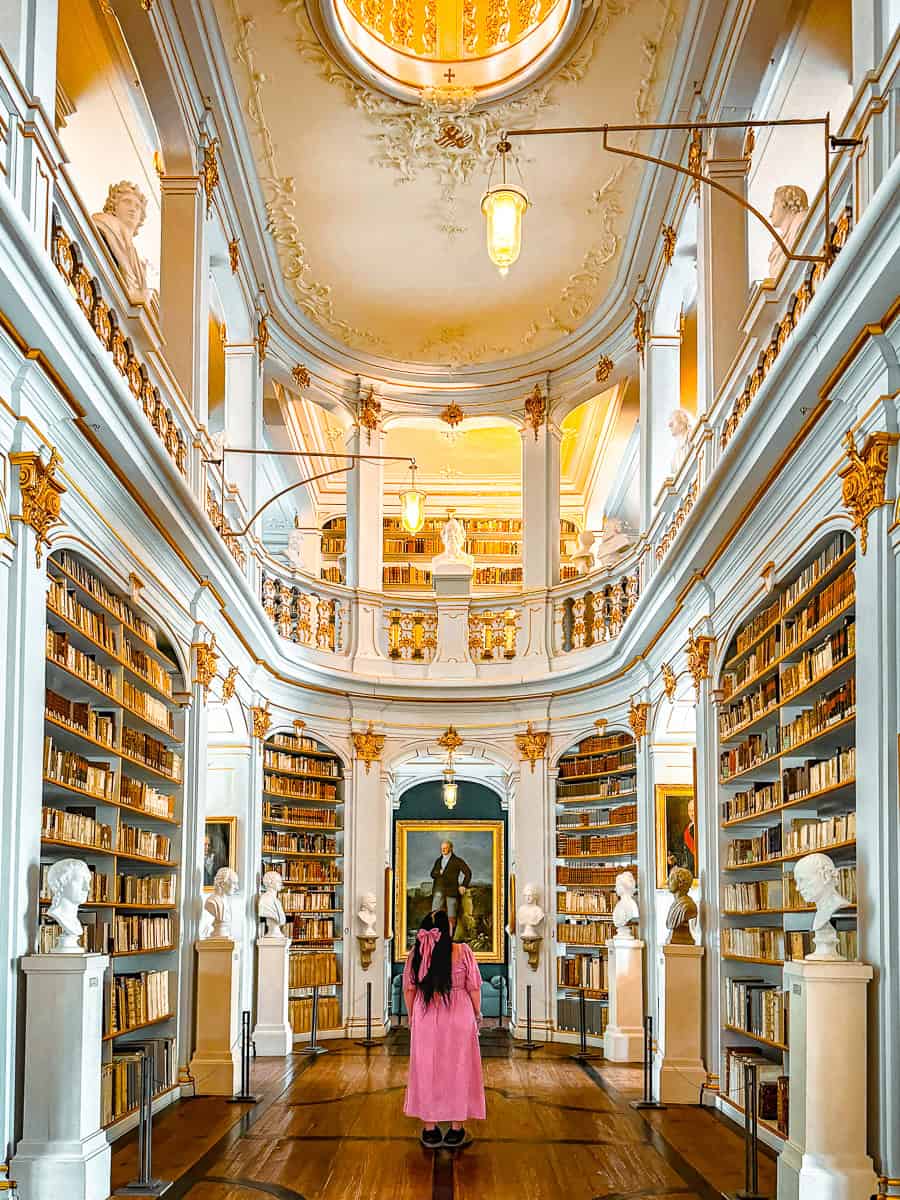
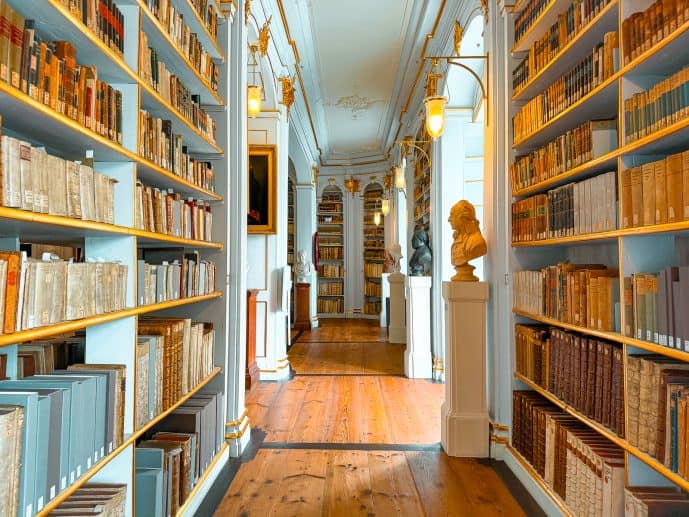
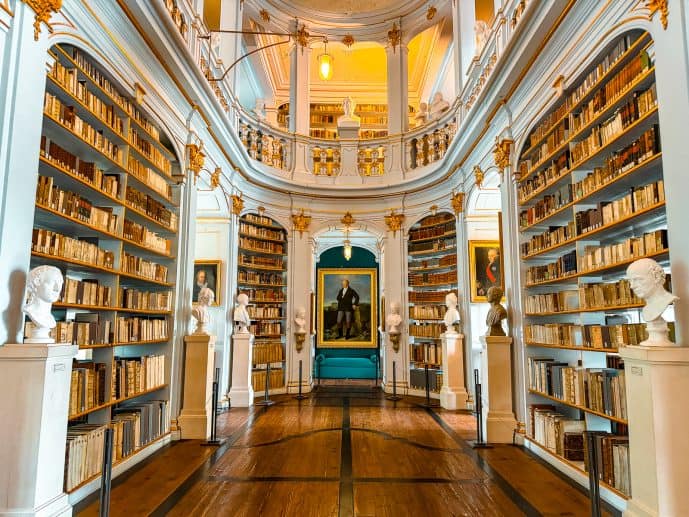
The jewel in the crown of the Duchess Anna Amalia Library is the breathtaking Rococo Hall.
As soon as I stepped inside I gasped and was utterly blown away. It felt like a library out of a fairytale such as Beauty and the Beast.
I entered the Rococo Hall first on my visit so I actually had it to myself for a few moments and I could really relish in it.
I wish I could share the smell of the parchment through the screen as it was just perfection!
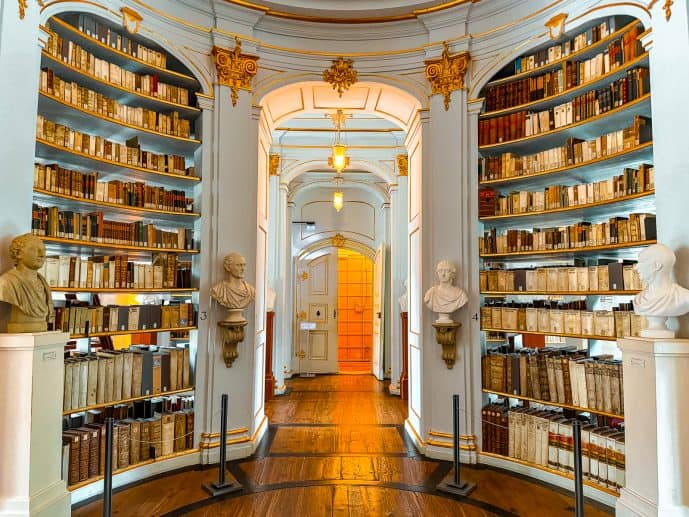
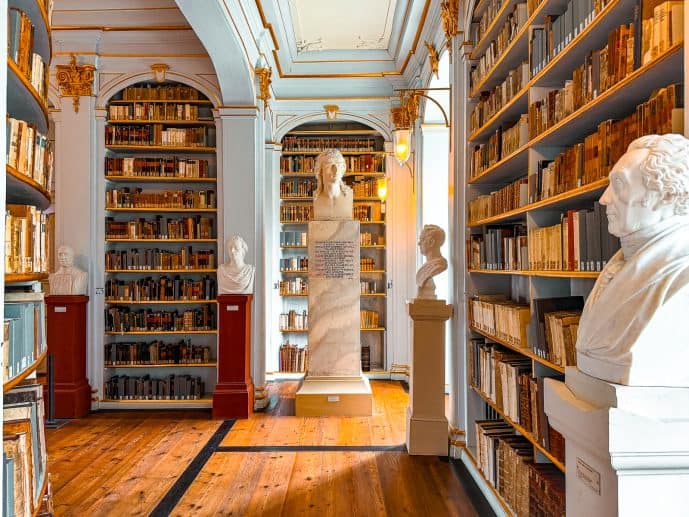
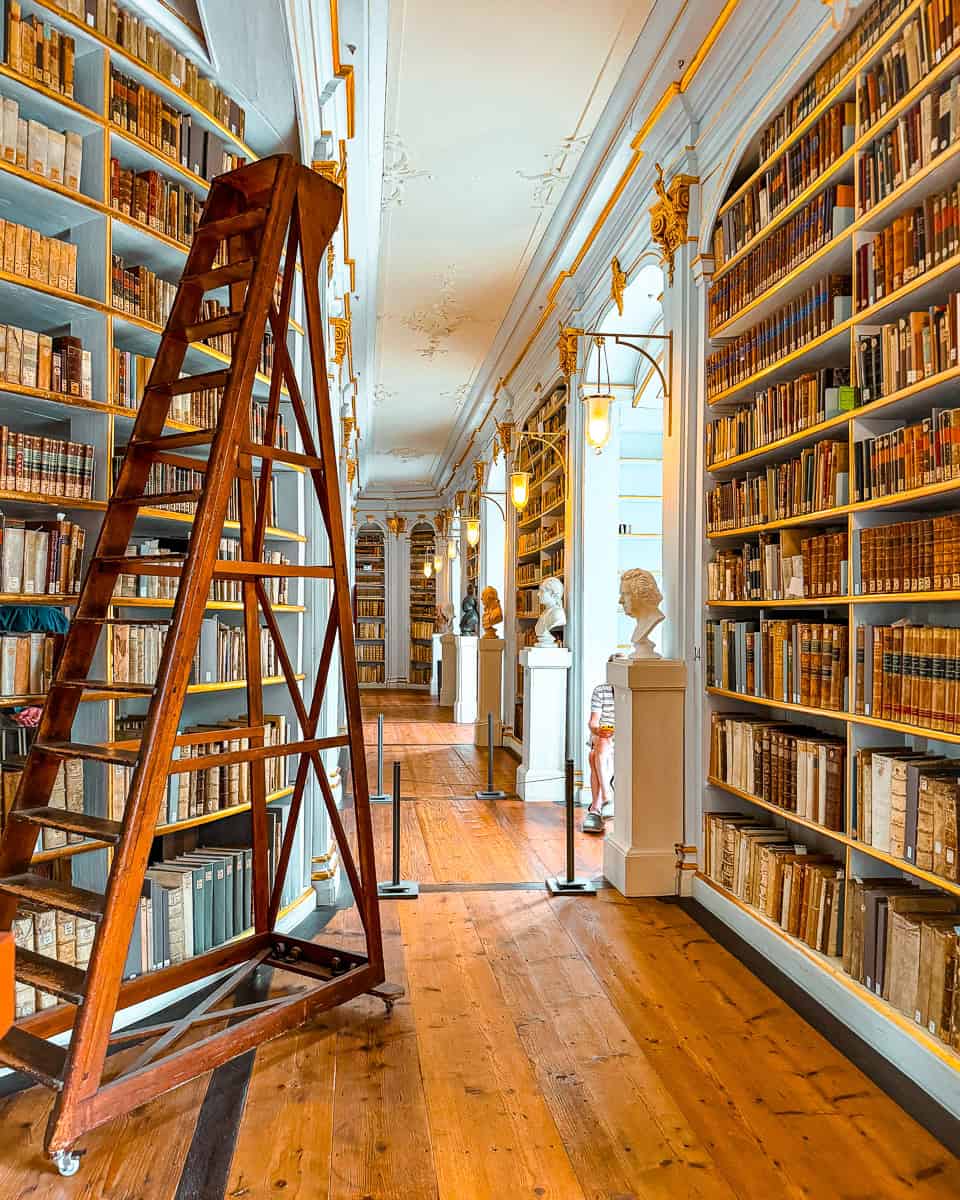
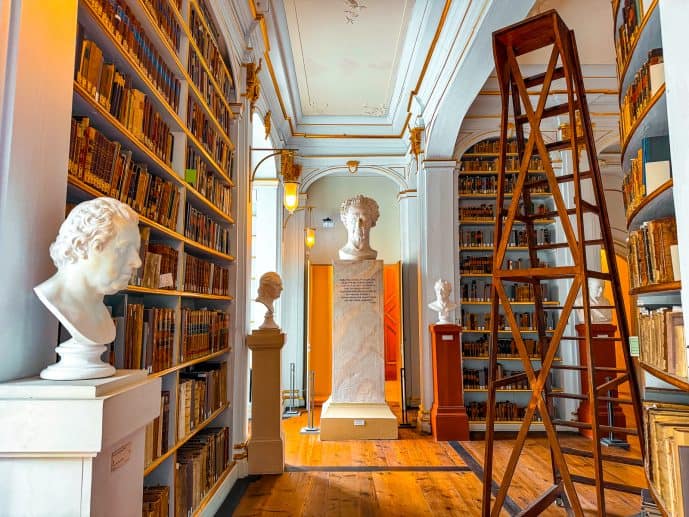
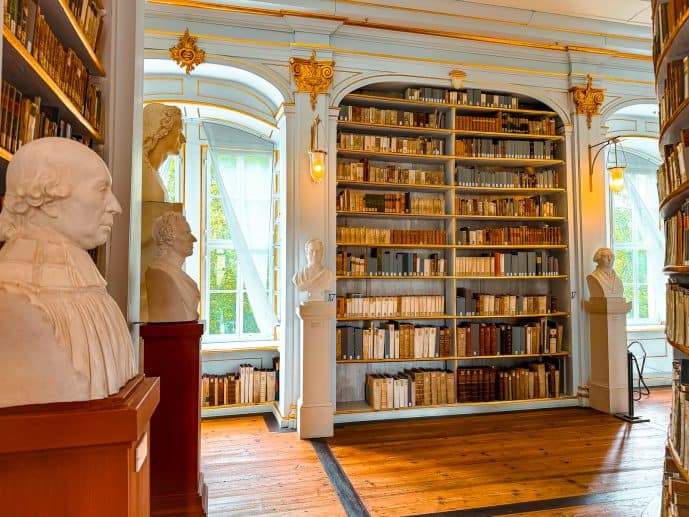
There is an oval interior with three levels decorated in gleaming white paint and gold filigree.
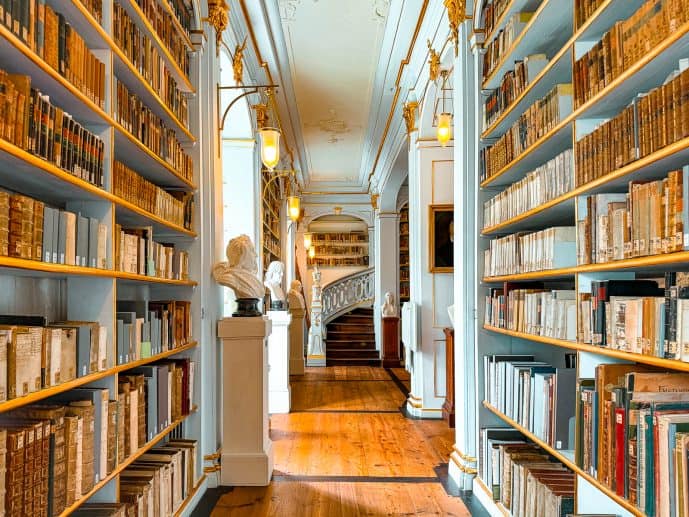
There are also twelve pilasters with frames of bookshelves.

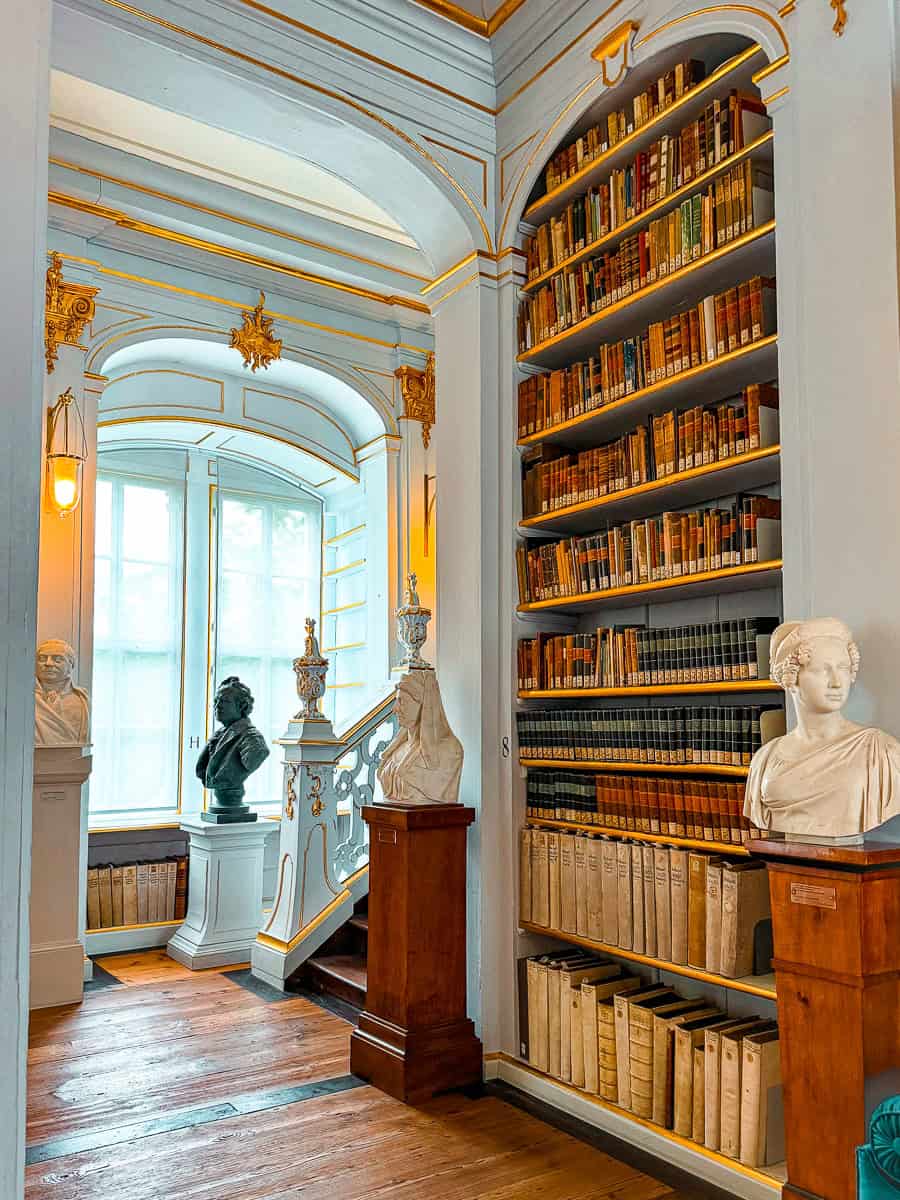
These shelves contain masses of antique volumes focussing on German literature from the Romantic and Classical eras.
You can also find all sorts of portraits around the space of the ducal family like Duchess Anna Amalia.
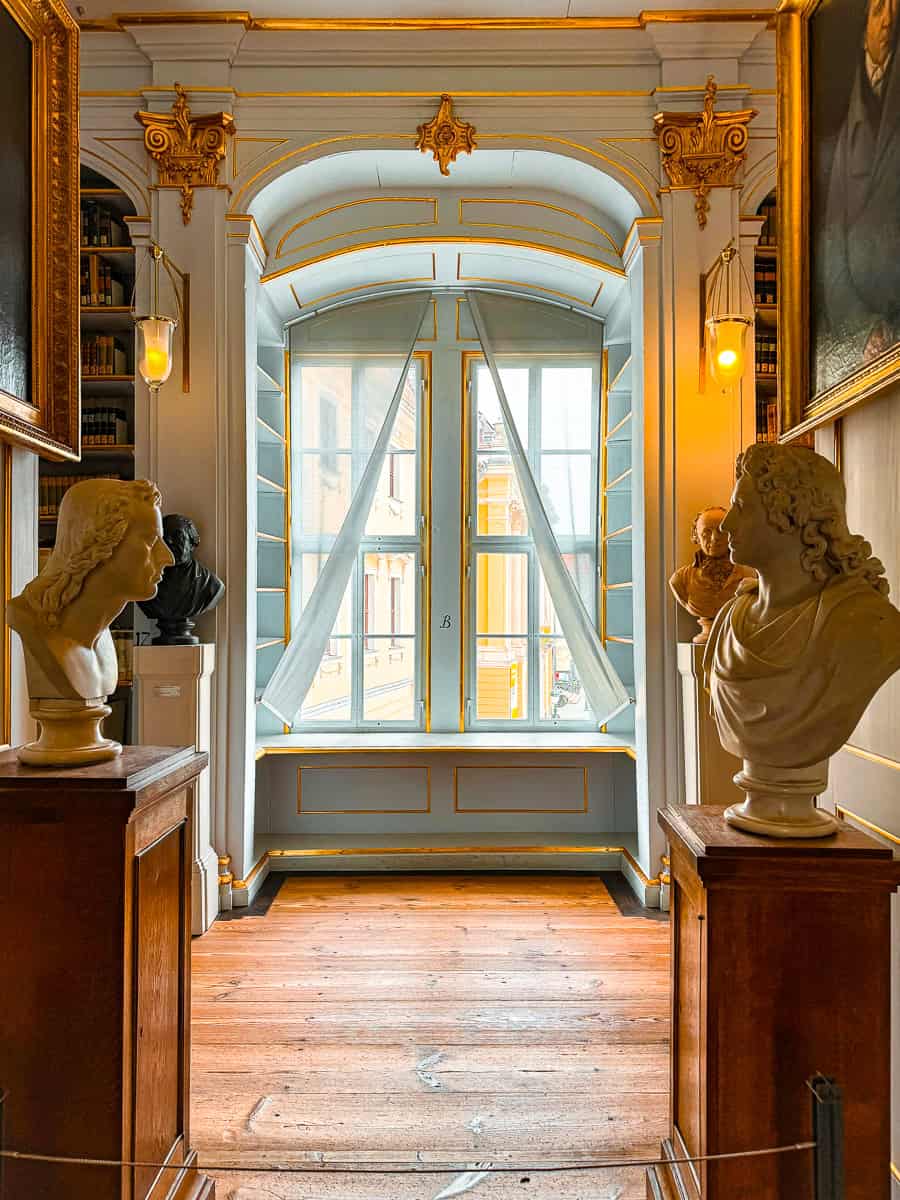
Classicist writers are also commemorated with portrait busts known as the ‘Gallery of Geniuses’.
This was commissioned by Carl August, the son of the duchess.
There are two alcoves with seating by the windows you can relax on to listen to your audio guide should you need a rest.
Audio guide & augmented reality
One of the coolest parts of visiting this library was the audio guide with augmented reality.
You can either opt to take one of their guides with a touch screen or download the App Weimar+ on your phone (remember headphones).
I downloaded the app and I found the commentary to be incredibly insightful.
However, the best part was the fact that you could take a look inside some of the books virtually with augmented reality called “Bang it Open”.
Simply scan the QR code by the book and it will pop out of the shelf and appear on your screen as if by magic!
You can then peruse it at your leisure. I thought this was really innovative and a great way to explore the library.
Genius of Fame
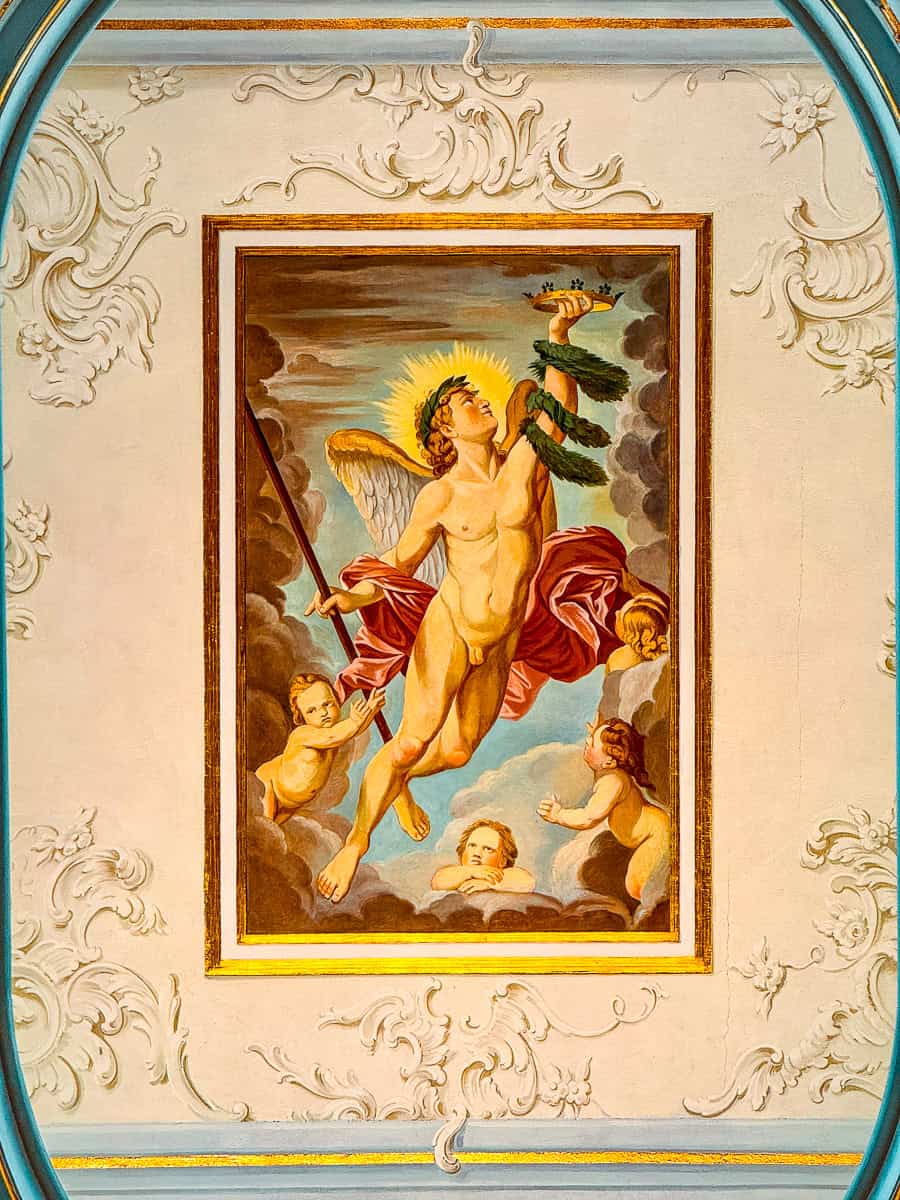
Before you leave, don’t forget to visit the centre of the room and look up for a nice surprise of the Genius of Fame.
It was originally painted in the 16th century by Italian painter Annibale Carracci.
Then, it was freely copied by Johann Heinrich Meyer to feature in the library.
After the fire, it was once again copied. So, this painting is a copy of a copy!
The winged youth wears a laurel on his head to represent his genius. He hands a crown and four victory wreaths to the immortals in heaven.
The library sees this painting as an appropriate motto: “Whoever supports the arts, sciences and literature will reap fame and honour”.
How long do you need to visit the Duchess Anna Amalia Library?
I would say that you need around 1 hour to visit the library and precious books exhibition.
Add more time if you’re also planning on visiting the Cranach Gallery.
But, if you are into your Baroque architecture and historic libraries you could easily spend hours here.
The audio guide is very informative and has some extra chapters you can listen to if you are eager.
I recommend savouring your visit and listening to it all as this library has a wonderful tale to tell.
Honestly, there are so many stunning details to admire in this breathtaking book trove. I had a hard time saying goodbye!
Don’t miss Cranach’s Torrent of Images
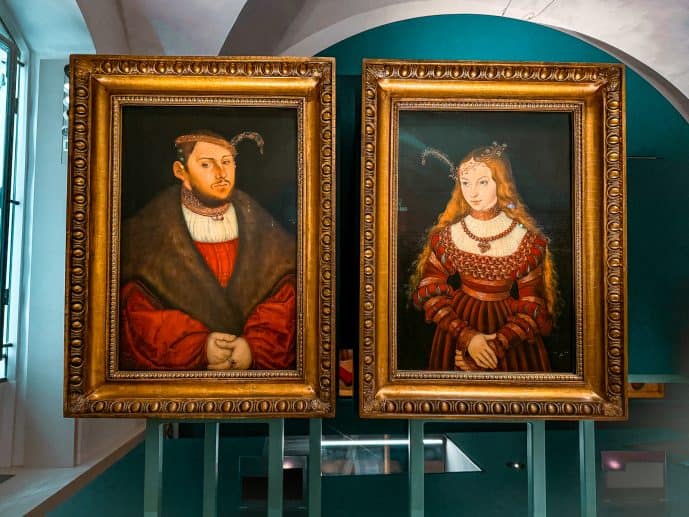
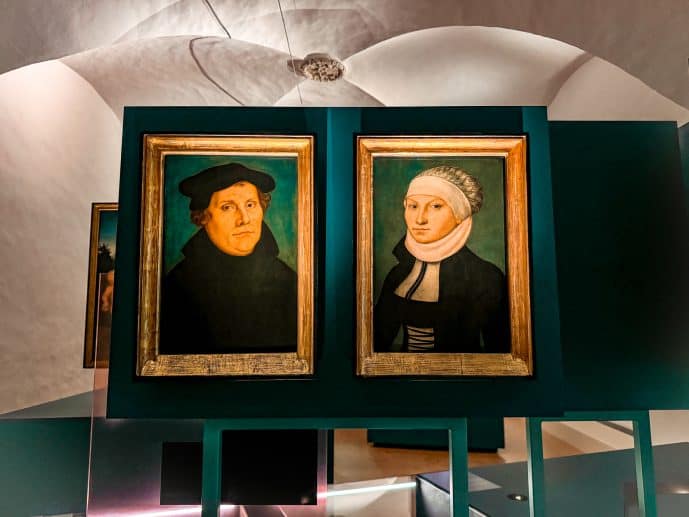
If you have time, I highly recommend visiting their Cranach Gallery in the Renaissance Hall.
It requires an extra ticket but it’s a delightful exhibition of the talented works of Lucas Cranach the Elder and Younger from their shared workshop.
There are some stunning portraits and landscapes inside. I particularly loved the bridal portrait of Sybille of Cleves of the House of La Marck.
If the name sounds familiar, then you may be interested to know that she was the ‘other daughter of Cleves’.
Her sister was the famous Anne of Cleves who married King Henry VIII of England for a short while.
Unlike her predecessors, Anne was able to keep her head and survived by divorcing him.
There is also an original Luther Bible of 1534 which has stunning pages of artwork and scripture.
The one on display only has two pages to see to protect the rest of the pages.
If you want a closer look, they have an interactive screen with a scanned copy of the highlights!
There were even rare portraits of Martin Luther and medals that were made in his honour. The entire exhibition was fascinating.
Military Library in the Book Tower (Bücherturm)
Another bookish location that you may be interested in is their book tower or Bücherturm.
This used to be a city wall turret but they converted the space into a library in 1825. Ever since it’s been home to a military library.
The space is stunning with a cupola showcasing a twelve-ray sun and a spiral staircase where you can explore the bookshelves.
Again, visits to the book tower are extremely limited for conservation purposes.

They offer one tour of the tower every Sunday at 11 am for just 10 participants. You can book a tour online.
Is the Duchess Anna Amalia Library worth visiting?
Most definitely. In fact, I think this is one of the prettiest libraries that you can find in all of Germany.
Yes, it’s partly a reconstruction but this shimmering white and gold Rococo Hall has a fascinating history and is breathtaking to behold.
I felt like a Princess wandering among the impressive busts and antique tomes.
Just make sure to book your tickets well in advance as its exclusivity means you may miss out.
My top tips to ensure a smooth visit
- Bring cash – although the library takes card payments, cash is still king in the rest of Weimar. Most coffee shops and bakeries don’t take cards.
- Book tickets online – to ensure entry, I would book your tickets online as soon as you are able.
- Get there for opening time – if you don’t have a ticket, get there just before opening time for the best chance of getting inside.
- Buy a combo ticket – I recommend buying a combination ticket for the Cranach Gallery.
- Photography and video – are both allowed but you can’t use flash. Tripods and selfie sticks are prohibited.
Why not visit the Book Cube in the student library next?
Just down the road from the Duchess Anna Amalia Library, you can find a student library which is worth a peek.
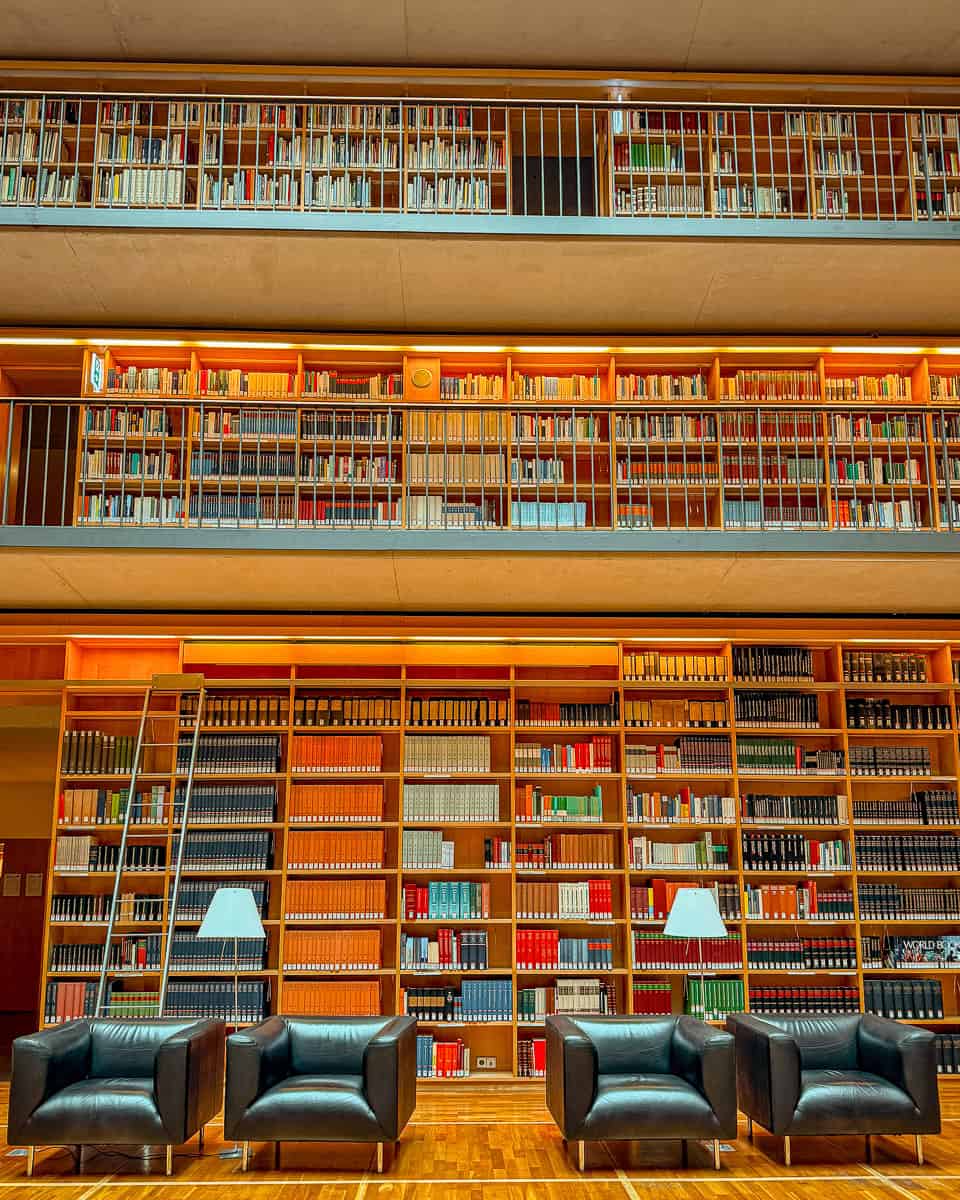
It’s a modern library that is usually for students, but you can visit the ‘Book Cube’ central hall for free as a visitor.
The entire cube is lined with thousands of volumes and the shelves are accessed by book ladders straight out of Beauty and the Beast.
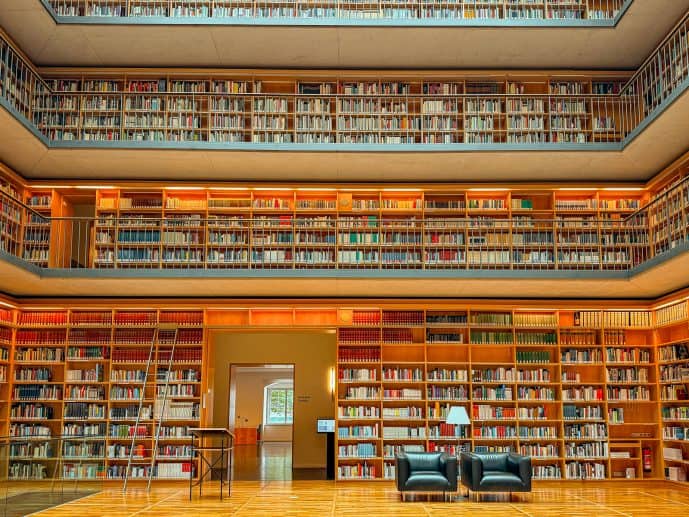
It’s the perfect place to relax for a while and they have some sofas to perch on.
To visit the upper floors of the library you must be a library member or have a student card. You can enquire about a day pass at the reception desk.
There was also a lovely café in the courtyard that had outdoor seating. I had a scrumptious coffee and chocolate cookie there after my library visit!
Goethe and Schiller Archive
One of my favourite literary attractions in Weimar is the Goethe and Schiller Archive
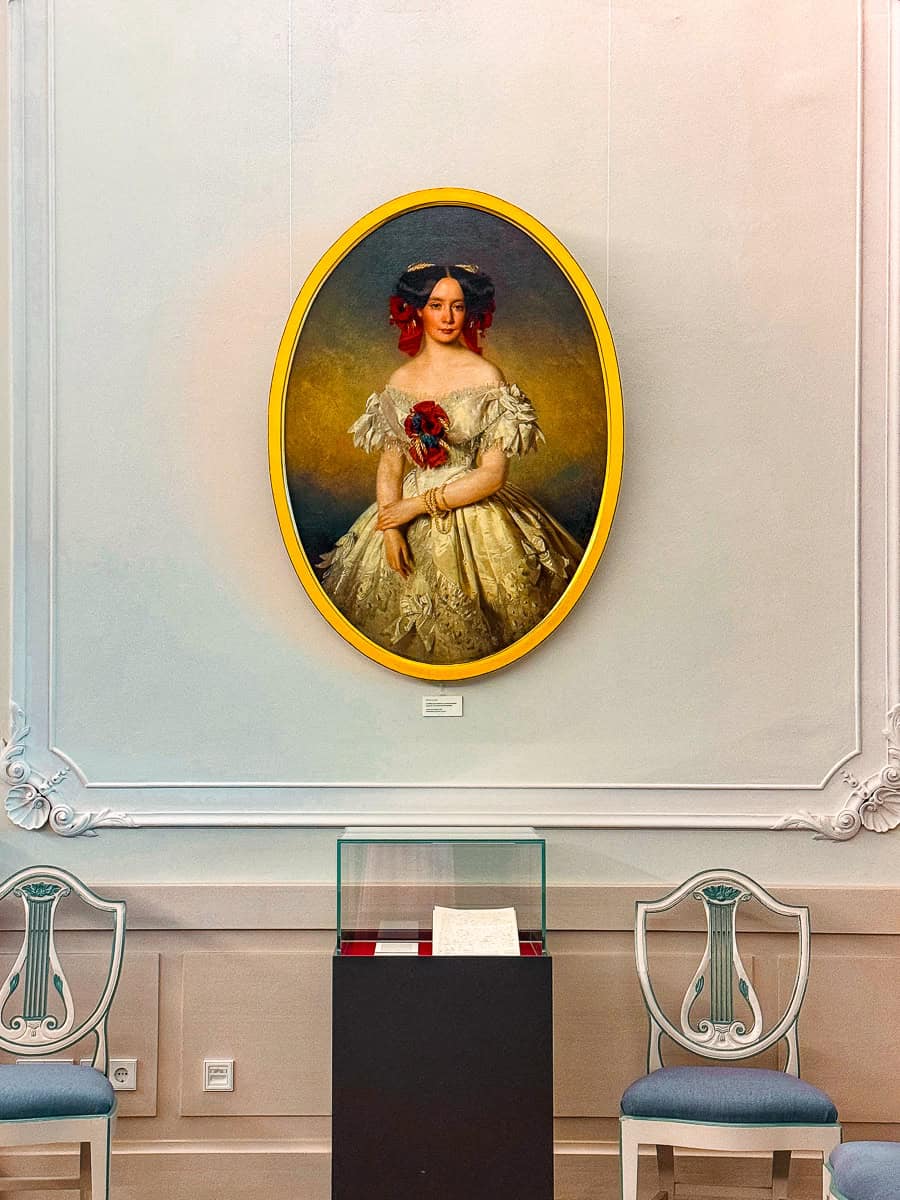
In 1885, Grand Duchess Sophie of Saxony-Weimar-Eisenach became the sole heiress of Goethe’s literary estate.
She then set up an ambitious project to protect his works via an archive but was met with much contention and controversy as she was a noble lady.
The archive eventually opened in 1896 and is now seen as one of the great literary and cultural conservation efforts in the country.
On your visit, you can learn about Sophie’s life and the events leading up to opening the archive.
This was nearly at the expense of Duchess Sophie’s reputation and marriage.
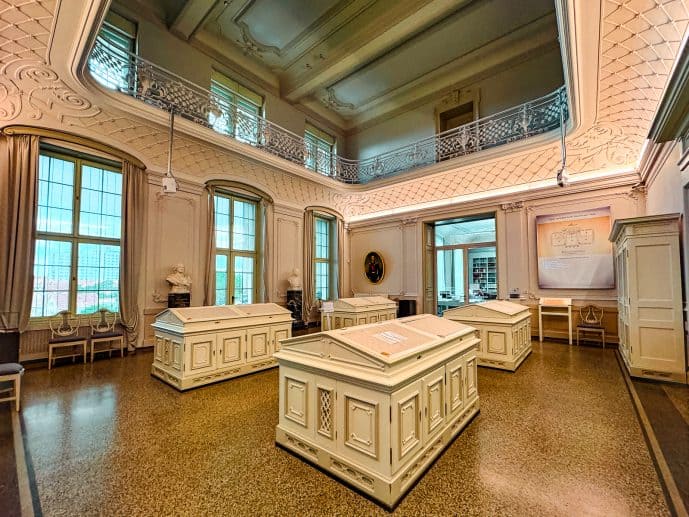
There are letters, manuscripts, telegrams, newspaper clippings, rare books, personal items and iPads with a digital library to browse.
Also, there are some quite scandalous excerpts that Sophie had redacted that were seen as inappropriate for delicate society.
It’s a bit of a hidden gem as I was the only visitor for around an hour. It made me sad as she was such a fascinating woman to learn about.
Entrance is completely free and it’s set in a gorgeous historic building that has an outdoor seating area with panoramic views over the city below.
Other literary destinations in Weimar
Although the library is stunning, Weimar has a wealth of literary destinations to uncover on your visit. It’s a haven for reading lovers.
If you didn’t know, Weimar is known as the birthplace of Weimar Classicism.
Furthermore, two famous German authors lived here; Goethe and Schiller.
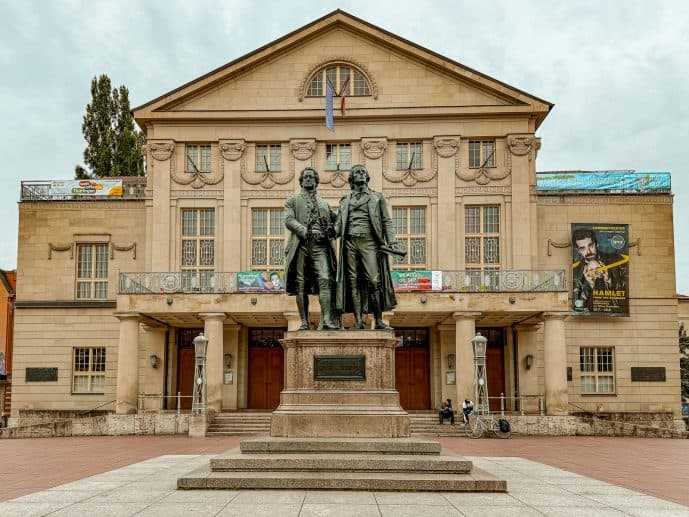
You can see a statue of them both in the Marktplatz which makes a great photo opportunity.
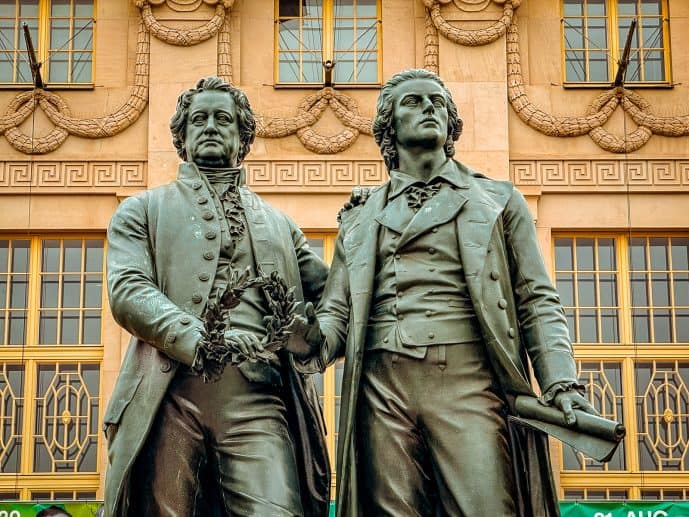
For Goethe lovers, you can visit his residence, garden house and the Goethe National Museum.
For Schiller, there is also a central museum, Bauerbach museum and the Schiller residence.
Although not literary, you can also visit the Bauhaus Museum which celebrates the free arts, design and architecture movement.
And if you love Baroque architecture, you must visit the Stadtschloss and the stunning summer residence of Belvedere Castle and Park.
I had such a lovely time in Weimar and it’s an underestimated tourist destination in Germany. You must go!
Recommended Travel Resources
–
Read more of my Germany travel guides
How to visit the magical Munich Law Library
How to visit the hidden gem Justizpalast Munich
The baroque hidden gem of Asamkirche
How to visit Wiblingen Abbey Library
Is it worth going inside Neuschwanstein Castle
Visiting Neuschwanstein Castle in winter
Why you shouldn’t skip Hohenschwangau Castle
Visiting Charlottenburg Palace in Berlin
Tips for visiting the Brandenburg Gate
Upper Lusatian Library of Sciences
Pfunds Molkerei – Most Beautiful Dairy Shop in the World
How to visit the Drachenschlucht in Eisenach (Dragon Gorge)
Discover Germany

Save the Duchess Anna Amalia Library for later!